The main difference between commercial and residential irrigation installation is the scale of water demand, the grade of piping materials used, and the legal requirement for backflow certification and municipal permitting. Residential systems are built for simplicity and comfort. Commercial systems are engineered for durability, liability control, and long-term water cost management. That single difference explains why expectations, timelines, and budgets feel very different for each. Below, you’ll find a clear breakdown of what to expect, without fluff, written for people who actually need to make a decision.
Understanding the Scope: Why Residential and Commercial Irrigation Feel Worlds Apart
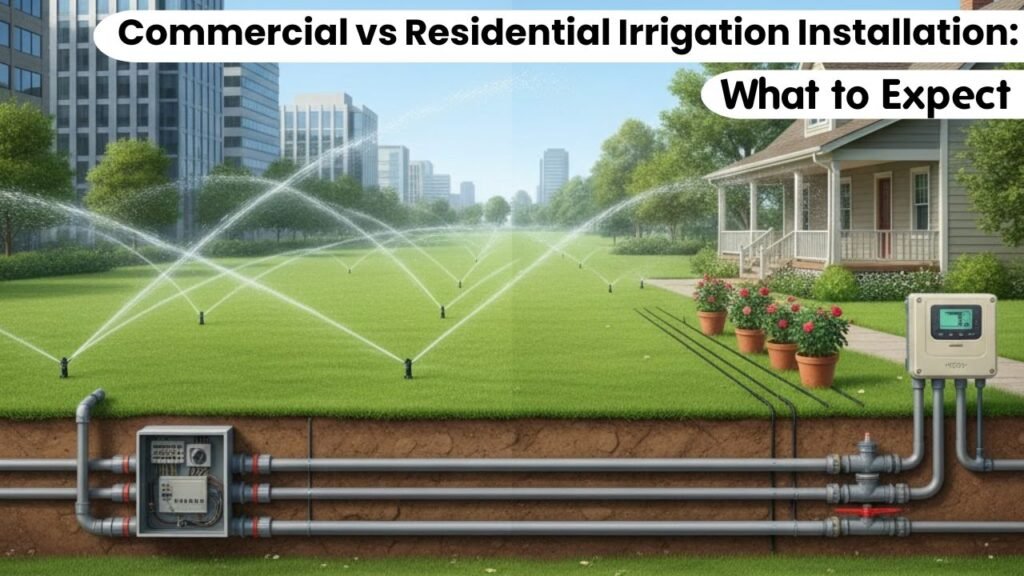
Residential irrigation is personal. It’s about lawns looking good, plants staying alive, and not having to drag hoses around. Most systems are small, predictable, and forgiving if something goes wrong. Commercial irrigation is operational. It supports public spaces, employee areas, storefronts, and shared landscapes. When it fails, the problems stack up fast. Higher water bills. Dead turf. Safety complaints. Even legal exposure. That’s why commercial systems are designed with redundancy, zoning accuracy, and stricter controls. Scale changes how everything is planned, installed, and maintained.
Water Demand, GPM, and Pressure: The First Reality Check
One of the first questions people ask is, “Why does commercial irrigation cost so much more?” The answer usually starts with Gallons Per Minute (GPM).
- A typical residential lot around a quarter acre may only need 10–15 GPM to run efficiently.
- A multi-acre commercial site can demand 80–150+ GPM, sometimes more, depending on turf density and hydro-zoning.
That much water changes pipe size, valve selection, and pressure regulation. Commercial systems often connect at a dedicated Point-of-Connection (POC) with higher PSI, requiring pressure-reducing valves to protect lateral lines and sprinkler heads from damage. This isn’t overengineering. It’s survival at scale.
Pipe Materials and Schedules: Not All PVC Is the Same
Residential irrigation typically uses Schedule 40 PVC or poly pipe. It’s affordable and works well for lower pressure systems. Commercial irrigation steps up the materials:
- Class 200 PVC or Schedule 80 PVC for mainlines
- HDPE piping for long runs or high-stress areas
- Occasionally ductile iron near the water source
Thicker walls mean fewer breaks. Fewer breaks mean fewer emergency repairs and less downtime. Over time, that difference pays for itself, even if it doesn’t feel like it upfront.
Backflow Prevention: A Legal Requirement, Not an Upgrade
Backflow protection isn’t optional. It’s enforced. Residential systems often use:
- Pressure Vacuum Breakers (PVB)
- Double Check Valves (DCV)
Commercial systems usually require:
- Reduced Pressure Zone (RPZ) valves
RPZ valves must be installed by certified professionals and tested regularly. They protect the potable water supply from fertilizers and chemicals entering the system. Expect inspection reports and annual testing as part of ownership. Skipping this step can shut a project down fast.
Zoning, ET Data, and Water Conservation Expectations
Residential zoning is basic. Front yard, back yard, beds, drip irrigation. Simple schedules. Commercial systems rely on hydro-zoning and Evapotranspiration (ET) data. Shaded areas, sunny slopes, and high-runoff zones all need different watering strategies. Smart controllers use cycle-and-soak programming to reduce runoff and meet water conservation rules. This is where many commercial systems save real money over time.
The Installation Process: What to Expect Step by Step
Design, Permits, and Licensing
Residential installs rarely require stamped plans. Commercial installs often require:
- Commercial plumbing permits
- Engineered irrigation drawings
- Landscape architectural stamps
- Verification of a state-specific Licensed Irrigator (LI) credential, since many jurisdictions require higher licensing for commercial taps than for residential work
This phase alone can take weeks.
Utility Locating and Site Prep
Calling 811 is mandatory. But here’s the catch. Private Utility Locating:
811 does not mark private lines on commercial campuses; property owners must expect to hire a private locating service for internal power, data, and existing water lines. This is a common surprise cost. Plan for it.
Trenching, Boring, and Site Disruption
Residential installs usually finish in 1–2 days.
Commercial projects may take weeks or months, especially if they involve:
- Boring under sidewalks or pavement
- Phased construction to keep areas open
- OSHA safety fencing and signage
- Coordination with other contractors
Noise, dust, and access planning are normal here.
Build-Out, Testing, and Commissioning
Commercial systems are pressure-tested, calibrated, and documented. Flow sensors are set. Master valves are tested. Controllers are programmed using ET data. Nothing is rushed, because mistakes get expensive later.
Cost Breakdown: What You’re Really Paying For
| Feature | Residential Irrigation | Commercial Irrigation |
|---|---|---|
| Typical GPM | 10–15 GPM | 80–150+ GPM |
| Primary Material | Schedule 40 PVC / Poly Pipe | Schedule 80 PVC / HDPE / Ductile Iron |
| Permit Requirements | Rare | Required |
| Cost per Zone | Lower | Higher |
| Warranty Length | 1–2 years labor & parts | 1 year labor, 5+ years parts |
Hidden Commercial-Only Costs to Expect
- Water connection or tap fees
- Hydraulic analysis reports
- RPZ testing and certification
- As-built map digitization
- Compliance documentation
These aren’t upsells. They’re part of doing it right.
Maintenance vs Irrigation Auditing: Know the Difference
Residential systems usually get serviced twice a year. Startup and winterization. Commercial systems require ongoing care and often Certified Landscape Irrigation Audits (CLIA). These audits measure efficiency, distribution uniformity, and compliance. They’re commonly required for water rebates, municipal reporting, or LEED standards. Auditing is about proof. Not just performance.
Winterization: Equipment Expectations Matter
Home systems can be winterised with small portable compressors. Commercial systems are different. Expect tow-behind air compressors rated at 185+ CFM to safely clear large-diameter mainlines without damaging solenoid valves or fittings. Anything smaller risks trapped water and freeze damage. This is not a DIY task.
Public Safety, Liability, and System Security
Commercial irrigation must consider people, not just plants.
- Low-profile or recessed sprinkler heads reduce trip hazards
- Heavy-duty rotors handle foot traffic
- Solenoid valve enclosures are often lockable or bolt-down to prevent tampering
Residential valve boxes sit in dirt. Commercial vaults protect infrastructure and reduce liability exposure.
Final Thoughts
Residential irrigation is about comfort and convenience. Commercial irrigation is about control, compliance, and risk reduction. Once you understand that difference, the timelines, materials, and costs make sense. Good irrigation isn’t cheap. Bad irrigation is far more expensive later.