A sprinkler emergency never waits for a good time. One minute everything is quiet. Next minute, water is gushing, soil is washing away, and you’re watching it creep toward your foundation. This isn’t just a lawn issue anymore. It’s a property-level problem.
I’ve spent decades around irrigation systems, failures, and cleanups. When systems fail, they fail fast. The goal right now is not a perfect repair. The goal is control. Stop the water. Reduce damage. Then think clearly. Let’s start with the one section that matters most.
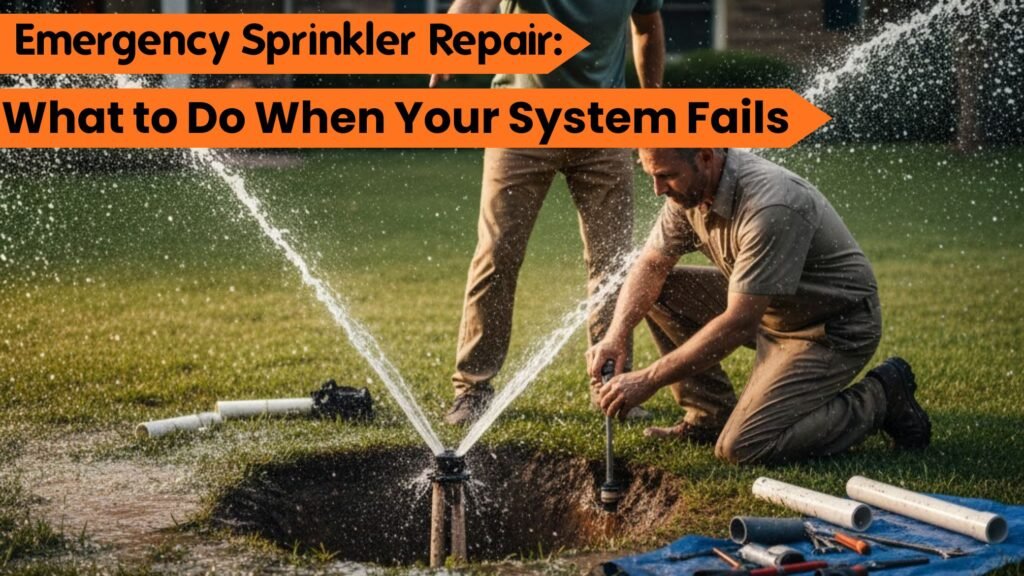
How to Shut Off a Sprinkler System in an Emergency
Do this immediately. In order. Don’t overthink it.
- Find the irrigation shut-off valve at the Point of Connection (POC).
This is where the irrigation system connects to the domestic water supply. Look near the backflow preventer or inside a green rectangular box close to the street or water meter. - Turn the handle 90 degrees to OFF.
- Ball valve: handle goes perpendicular to the pipe.
- Gate valve: turn clockwise until it stops.
- Unplug the irrigation controller or switch it to “System Off.”
This kills all electrical signals to the solenoids. - Confirm water has stopped flowing.
Check your Leak Indicator on the water meter. It’s the small triangle or star. If it’s still spinning, water is still moving somewhere.
If you cannot find the irrigation shut-off, your final fail-safe is the main water meter. Turning that valve will shut off water to the entire property and instantly stop the irrigation emergency.
Definition (Emergency Reference)
An irrigation emergency occurs when a main line burst, valve failure, or backflow malfunction causes uncontrolled water flow under constant static pressure. The immediate response is to shut off the irrigation isolation valve at the Point of Connection and confirm flow has stopped using the water meter.
What Kind of Sprinkler Emergency Is This?
Not all sprinkler failures are equal. Knowing the severity tells you how fast you must act.
Broken Sprinkler Head – Severity 2 (Fix Today)
What you see
- A geyser when the zone runs
- Water stops when the system is off
What’s happening
- A head snapped or blew out
- This is a lateral line issue
Risk is lower because water only flows when the zone runs. Still messy. Usually fixable the same day.
Stuck Zone Valve – Severity 3
What you see
- One zone runs nonstop
- Water continues even after controller is unplugged
What’s happening
- Mechanical valve failure
- Diaphragm stuck open from debris or age
If the controller is unplugged and water still runs, it’s not electrical. It’s mechanical. That’s an important clue.
STOP – DANGER
Main Line Leak or Sinkhole – Severity 5
What you see
- Water runs constantly
- Soil collapsing or bubbling
- Flow continues with controller unplugged
What’s happening
- Main line before the valve has failed
- This pipe is under constant static pressure and constant flow
A 1-inch main line burst can lose 30–50 GPM (Gallons Per Minute). That’s up to 3,000 gallons per hour dumping into soil near your foundation. This is why main line failures are true emergencies.
Temporary Emergency Fixes
These steps buy you time. They are not the final repair.
How to Cap a Line Temporarily
If a section is destroyed and you need water restored elsewhere:
- Cut the damaged Schedule 40 PVC clean and straight
- Dry the pipe completely
- Prime and glue on a PVC slip-cap
- Let it cure before re-pressurizing
Swapping a Solenoid
If a zone won’t turn on or off:
- Shut off irrigation water
- Unscrew the solenoid by hand
- Install a matching replacement
- Hand-tighten only
This often restores control long enough to plan a proper fix.
The Slow Recharge
Before turning water back on:
- Open the shut-off valve only 10% at first
- Let the system pressurize slowly
- Listen for banging or shock
This slow-fill prevents water hammer, which causes secondary pipe bursts after emergency repairs.
DANGER – FOUNDATION RISK
The Foundation Danger Zone
Uncontrolled irrigation water near a structure is serious. In areas with expansive soils, sudden saturation causes soil to swell. That creates lateral pressure against foundation walls and slabs.
Damage can include:
- Foundation cracks
- Basement or crawlspace flooding
- Long-term structural movement
Hydrostatic pressure builds faster than people think. Sometimes in hours, not days.
What to Do While the Area Is Wet
- Divert remaining runoff away from the structure
- Avoid stepping near sinkholes
- Don’t collapse unstable soil
Let the area dry before permanent repairs.
When to Call Emergency Professional Help
Call immediately if:
- The irrigation shut-off valve is frozen or broken
- Water is entering the home
- The backflow preventer has cracked
- You cannot stop constant flow
Ask specifically for:
- A licensed irrigator
- Licensed backflow testers if the backflow assembly is involved
Backflow devices often require special certification.
Important Safety Step: Call 811
While waiting for soil to dry, call 811 (Call Before You Dig). It’s a free service. Even if you already found the leak, they will mark nearby gas and power lines before deeper excavation. This avoids turning one emergency into another.
Emergency Tools That Actually Help
| Emergency Problem | Tool or Part |
|---|---|
| Broken head | Replacement head or cap |
| Main line burst | PVC cutter, slip-cap |
| Stuck valve | Solenoid, screwdriver |
| Electrical issue | Multimeter |
| Ongoing erosion | Shovel, temporary diversion |
Speed matters more than brand in emergencies.
Will a broken sprinkler ruin my foundation?
Yes, if left running. Uncontrolled water causes erosion and hydrostatic pressure, which can lead to foundation cracks and basement flooding within hours.
How do I find my irrigation shut-off valve?
Look for a green rectangular box near the street or water meter. Inside you’ll find a ball valve or gate valve dedicated to the irrigation system.
My sprinkler valve box is full of water. How do I find the valve?
Bail the water out with a small cup or hand pump. If water refills immediately, the leak is likely inside the box. If it fills slowly, the leak is downstream in the pipe.
Final Thoughts
Emergency sprinkler repair is about control, not perfection.
Shut the water off. Protect the foundation. Then plan the repair with a clear head. Most damage happens because people hesitate or turn the water back on too fast.