A badly designed sprinkler system doesn’t just waste water. It wastes money every single week. In many homes, up to 40–50% of irrigation water never reaches plant roots. It runs off, evaporates, or sprays places it shouldn’t. The real fix is not watering longer. The solution is designing for efficiency from the start. When a system is designed the right way, lawns stay green, plants stay healthy, and water bills quietly drop. This guide breaks it down clearly, without fluff, using real-world practices used by irrigation pros for decades.
What Is the Most Efficient Sprinkler System Design?
The most efficient sprinkler system design is one that applies water evenly at the correct rate using hydrozoning, pressure regulation, matched precipitation rates, and weather-based irrigation scheduling to minimize runoff, overspray, and evaporation.
When these elements work together, irrigation efficiency improves without increasing runtime or water use.
Understanding Your Yard Before Any Design Starts
Every efficient system starts with understanding the site. Skipping this step is why many systems fail. Key things that must be evaluated:
- Soil type
Clay absorbs slowly and holds water longer. Sandy soil drains fast and needs shorter, frequent cycles. - Slope and grading
Slopes increase runoff risk and demand special scheduling. - Sun exposure
Full-sun turf zones dry faster than shaded areas. - Plant material
Turf, shrubs, and trees must be on separate zones. Mixing them always causes waste.
Water Supply (This Is Where Pros Pay Attention)
A system can only perform as well as the water feeding it. Important supply details include:
- Static pressure – pressure when no water is flowing
- Dynamic pressure – pressure while water is running (this is what design must use)
- Available flow (GPM)
- Meter size (¾” vs 1”)
- Service line size from the meter to the house
- Elevation head – for every 1 foot of elevation rise, you lose 0.433 PSI
That elevation loss adds up fast in yards with slopes or raised beds. It’s often ignored, and that causes weak coverage at the last head.
Hydrozoning Explained Simply
Hydrozoning means grouping plants with similar water needs together. Turf zones run differently than shrub zones. Trees are different again. This single concept alone can reduce water use a lot when done right.
Hydraulic Design & Pressure Regulation
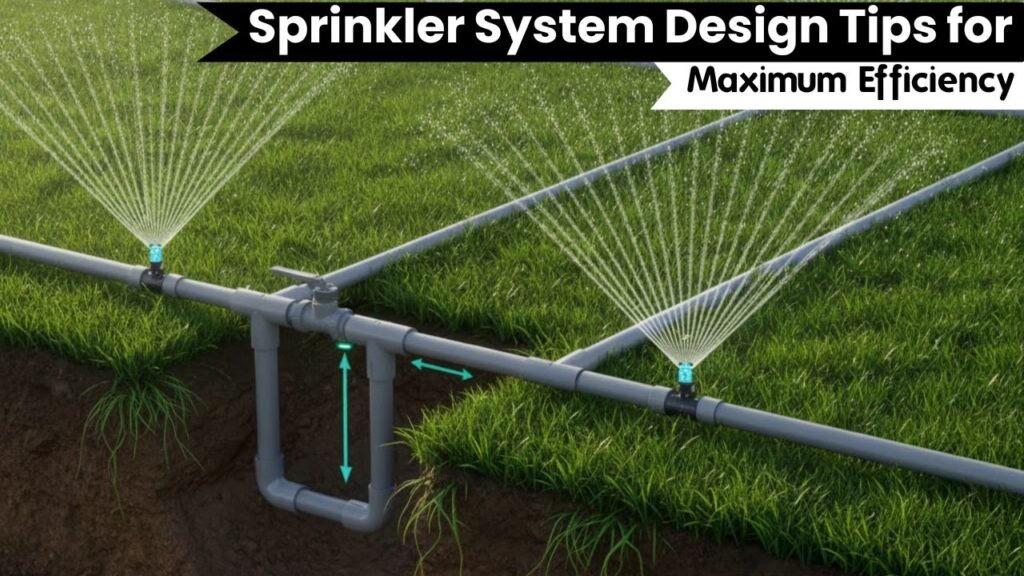
Hydraulics is the heart of sprinkler design. This is where efficiency is either locked in or lost. The pressure at the sprinkler head must be correct. Too high, water turns into mist. Too low, coverage collapses.
Static vs Dynamic Pressure
Static pressure looks great on a gauge. But it means nothing for design. Dynamic pressure, measured while water is flowing, is what determines real performance. Always design based on dynamic pressure.
Why Pressure Regulation Matters
High pressure causes:
- Misting
- Wind drift
- Uneven distribution
Low pressure causes:
- Dry spots
- Poor overlap
Modern efficient systems use:
- Pressure-regulated valves at the valve manifold
- PRS (Pressure Regulating Stems) inside sprinkler heads
In many regions, pressure-regulated heads are now required by code to prevent water waste.
Pipe Sizing and Velocity Limits
Pipe size affects friction loss and pressure stability. Common materials:
- Schedule 40 PVC for mainlines
- Class 200 / SDR-21 PVC for lateral lines
Water velocity should stay below 5 feet per second (fps). Higher speeds cause friction loss and can lead to water hammer, cracked fittings, and solenoid failure. Once pressure is stabilized, the next step in achieving uniform irrigation is proper head-to-head coverage.
Head-to-Head Coverage
Head-to-head coverage means each sprinkler throws water to the base of the next sprinkler. Not close. Not almost. Exactly. This overlap is essential because sprinklers apply the most water near the nozzle, not at the edge. Professionals measure this using:
- Distribution Uniformity (DU)
- Matched Precipitation Rates (MPR)
Matched Precipitation Rate Explained
To maintain MPR:
- A 90-degree head must use half the GPM of a 180-degree head
- A 90-degree head must use one-quarter the GPM of a 360-degree head
This ensures all areas receive water evenly, even with different arc patterns. Ignoring this rule creates wet and dry zones no matter how long you water.
Choosing the Right Sprinkler Components for Efficiency
Hardware choices matter more than brand names.
Rotary Nozzles vs Spray Heads
| Feature | Spray Heads | Rotary Nozzles |
|---|---|---|
| Precipitation Rate | High | Low |
| Wind Resistance | Poor | Excellent |
| Water Efficiency | Lower | Higher |
| Best Use Case | Narrow strips, small areas | Large turf areas, slopes |
Rotary nozzles apply water slowly, allowing better soil absorption and less runoff. For most lawns, they are the more efficient option.
Nozzle Trajectory and Wind Control
Nozzle trajectory is the angle at which water leaves the head. Lower trajectory nozzles keep water closer to the ground, reducing wind drift and evaporation. This is a major efficiency gain, especially in open or windy yards.
Smart Controllers and Weather-Based Scheduling
Today’s efficient systems rely on data, not guesswork. A Weather-Based Irrigation Controller (WBIC) adjusts watering automatically using climate data. Evapotranspiration (ET) is the sum of evaporation from the soil surface and plant transpiration. WBICs use ET data to calculate how much water plants actually need. Many systems also integrate:
- Soil moisture sensors, which prevent watering when soil already has enough moisture
- Rain sensors, which stop irrigation during rainfall
Look for controllers labeled EPA WaterSense, which meet strict efficiency standards.
Soil, Slope, and Cycle-and-Soak Scheduling
Soil and slope determine how water should be applied.
Cycle and Soak in Real Numbers
Instead of one long cycle that causes runoff:
- Run four 5-minute cycles
- Allow 30 minutes of soak time between cycles
This method allows water to infiltrate properly, even on slopes or compacted soil. Smart controllers handle this automatically.
Maintenance for Efficiency: System Audits Matter
A system is only efficient if it performs the way it was designed.
Catch Cup Test
The catch cup test measures real water distribution. Cups are placed evenly across a zone, the system runs, and collected water is measured. This data is used to calculate:
- Actual precipitation rate
- Scheduling Coefficient
Audits confirm whether zones are properly calibrated or just assumed to be.
Efficiency Killers to Avoid
These issues quietly destroy performance:
- Overspray onto sidewalks or driveways
- Mixing spray heads and rotors on the same zone
- Leaky riser seals and worn nozzles
- Ignoring pressure fluctuations
Fixing these alone can improve efficiency fast.
Final Thoughts
Efficient sprinkler system design is not complicated, but it is precise. When hydraulics, zoning, pressure control, and smart scheduling work together, water use drops without sacrificing results. Many utilities offer rebates for EPA WaterSense controllers and pressure-regulated heads. It’s worth checking before upgrading. A well-designed system doesn’t just water a lawn. It protects water, lowers costs, and performs reliably season after season.