You’re standing there with a broken sprinkler zone. Water isn’t flowing right. Or maybe it won’t shut off. You already Googled the part. It’s cheap. Then you got a quote that feels… not cheap at all. That’s where this decision usually starts. So let’s be direct. Is sprinkler repair worth doing yourself, or is hiring a professional actually the smarter move? This guide answers that exact question. No fluff. No scare tactics. Just a clear cost and risk analysis, written from years of seeing both DIY wins and very expensive DIY mistakes.
DIY vs Pro in Plain Terms
DIY sprinkler repair can save 70–80% upfront on simple jobs. But once repairs involve constant water pressure, buried lines, electrical wiring, or backflow devices, the risk rises fast. For high-pressure repairs, the value-to-risk ratio heavily favours professionals. Saving $200 in labour is rarely worth the $5,000+ risk of foundation erosion, flooding, or subsurface damage from a failed mainline repair. That’s the baseline. Now let’s break it down properly.
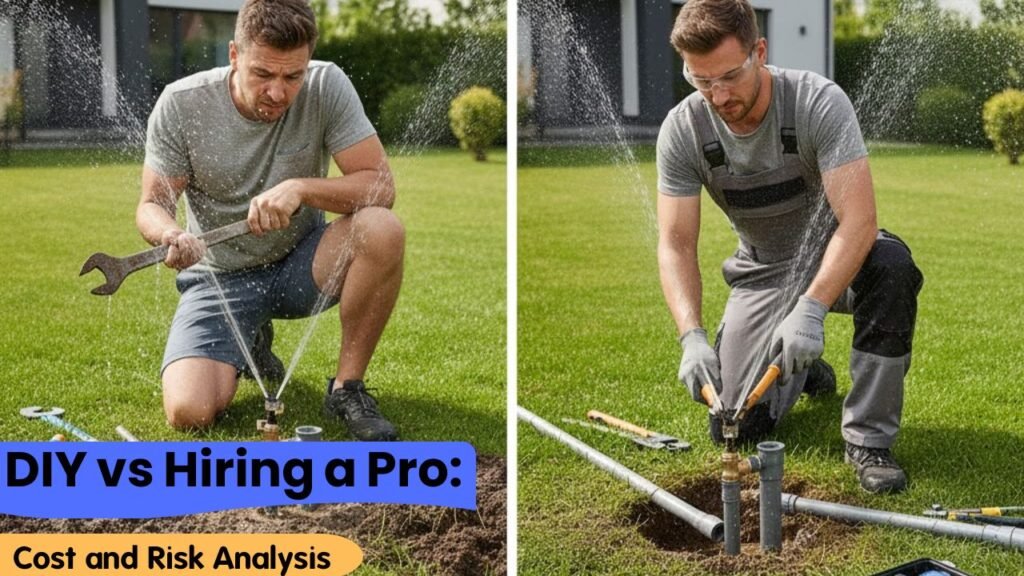
DIY vs Professional: Cost and Liability Comparison
| Factor | DIY Repair | Professional Repair |
|---|---|---|
| Typical Cost | $20 – $100 | $150 – $400 |
| Time Required | 2 – 6 hours | 45 – 90 minutes |
| Liability Protection | Homeowner responsible | Fully insured & bonded |
| Diagnostic Accuracy | Trial and error | Root-cause testing |
| Warranty | Manufacturer only | Workmanship + parts |
This table explains why both options exist. One saves cash. The other limits exposure.
What Are You Actually Paying For?
When you DIY, you’re paying for parts only.
- Spray head: $15–$30
- Solenoid: $20–$40
- PVC fittings and cement: $10–$25
When you hire a pro, you’re paying for:
- Labor rates
- Diagnostic accuracy
- Tool investment
- Liability insurance
- A workmanship warranty
That last one matters more than most people realize.
Manufacturer Warranty vs Workmanship Warranty
If a DIY nozzle fails, you might get a $5 refund. That’s it. If a pro-installed valve fails, the workmanship warranty usually covers the $150+ labor to come back, re-diagnose, and fix it. That warranty acts like insurance. It’s often what turns the higher upfront cost into long-term savings.
The Number Most DIYers Ignore
DIY isn’t free. You just pay with time. If your personal time is worth $50 per hour, a six-hour DIY repair quietly costs $300 in opportunity cost. That alone can exceed a flat-rate professional service call. And that doesn’t include:
- Extra trips to the hardware store
- Buying tools you may never use again
- Fixing mistakes made along the way
Sometimes DIY still wins. But not always.
Parts Swapping vs Root Cause Analysis
DIY repairs often start with guessing. Replace one part. Still broken. Replace another. That’s called parts swapping.
Professionals diagnose first. They:
- Test solenoids with a multimeter (healthy range 20–60 Ohms)
- Measure static vs dynamic PSI
- Confirm flow rates and friction loss
That root cause analysis prevents buying three parts to fix one problem. It also reduces water waste and repeat failures.
Legal and Safety Risk: Why 811 Is a Big Deal
Any repair involving digging carries real risk. Hitting a buried gas line or fibre-optic cable isn’t just inconvenient. It can create uninsured liability for the homeowner. Damage caused by unlicensed utility work may not be covered by your own insurance. Calling 811 before digging is mandatory. Even then, accidents happen. Licensed professionals carry general liability insurance that covers subsurface damage, including utility strikes. This protection alone is a major reason professional repairs cost more.
Backflow, Health, and Water Safety
This is where DIY clearly stops making sense. In the USA, irrigation systems are considered high-hazard connections. Backflow devices exist for cross-connection control, protecting the home’s potable water supply. A DIY backflow mistake doesn’t just flood a yard. During a pressure drop, fertilizer-laden irrigation water can siphon back into kitchen faucets. That’s a health issue, not just a repair issue. Backflow testing and repair usually require certification. This is firmly in “hire a pro” territory.
The DIY Complexity Scale
Not all repairs carry the same risk. This scale helps set expectations.
- Nozzle cleaning or replacement: 95% success (DIY recommended)
- Spray head replacement: 90% success
- Solenoid replacement: 60% success (technical skills needed)
- Lateral line PVC repair: 55% success
- Mainline PVC weld: 40% success (high blowout risk)
As complexity increases, savings shrink and consequences grow.
When DIY Goes Sideways: The Point of No Return
Here’s an honest rule many pros won’t tell you upfront. If you’ve cut into a valve manifold or opened a pressurized line and cannot get a leak-free seal after two attempts, stop. Professional “recovery” calls often cost more than the original repair. Why? Because the pro now has to undo improper cuts, rebuild fittings, and sometimes replace entire sections. Knowing when to stop can save hundreds.
Repair Tiers: Clear Decision Guide
DIY-Friendly Repairs
- Cleaning clogged nozzles
- Replacing spray heads
- Adjusting arcs and radius
- Installing smart controllers
Low risk. Mistakes are visible and cheap.
Intermediate Repairs (Caution)
- Solenoid swaps
- Lateral line leaks
- Basic wiring fixes
Possible DIY wins, but only with patience and tools.
Pro-Mandatory Repairs
- Mainline bursts
- Valve manifold rebuilds
- Backflow testing or replacement
- Electrical short troubleshooting
Here, the risk isn’t the part. It’s the consequence.
Why Quotes Feel Higher
Skilled-trade labor shortages mean many professionals now charge a minimum service call fee, no matter how small the fix. That makes DIY appealing for $20 repairs, but professional service more logical for full system audits or recurring issues. Understanding this helps manage expectations.
Final Verdict
The Verdict: Hire a professional for any repair involving the mainline, backflow preventer, or valve manifold to protect your home’s water safety and foundation. Save DIY for heads, nozzles, and smart controller setups, where the risk of property damage is minimal.
DIY saves money. Professionals reduce risk. Choosing based on repair complexity, not pride.