Sprinkler Zone Won’t Turn On? The Electrical Diagnostics Guide to Finding the Fix
“In irrigation, 80% of ‘mechanical’ failures are actually electrical signals that never arrived.”
Sprinklers are more than pipes—they rely on a hidden nervous system. Homeowners often assume a dead zone is a plumbing issue. The truth? Most failures are electrical. Understanding this prevents wasted parts, unnecessary digging, and repeated repairs.
Electrical diagnostics focus on three pillars:
- Controller Output (24VAC) – The “push” from the system’s brain.
- Station Wires – The “signal pathway” that carries instructions.
- Solenoid Coil – The “muscle” that opens the valve.
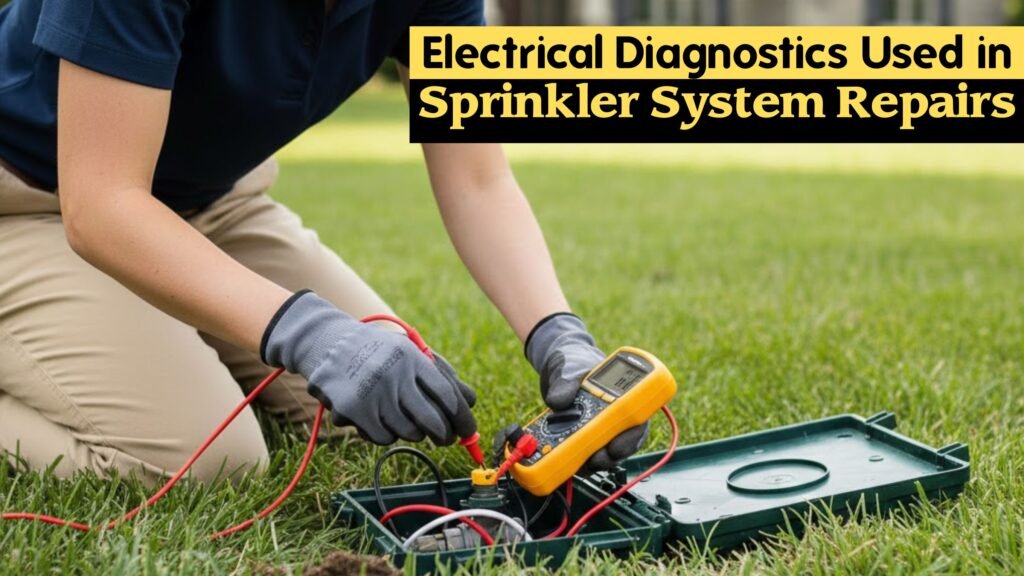
Using a Digital Multimeter (VOM), professionals measure Ohms, Volts AC, and current draw to determine whether a failure is a Short Circuit, Open Circuit, coil failure, or wiring issue.
The Invisible Infrastructure
Think of your irrigation system like a body:
- Controller: Brain
- Wires: Nerves
- Solenoids: Muscles
Most failures are not where water flows—they are where electrical signals stop. Professionals follow a Diagnostic Repair Hierarchy, where Visual Inspection identifies the symptom; Flow Testing identifies the source.
Entities: Circuit integrity, electrical continuity, 24-volt AC systems, diagnostic workflow.
How to Tell if a Solenoid is Bad Using Ohms and Resistance
A solenoid’s resistance-to-current ratio is crucial. Residential 24VAC solenoids typically read 20–60 Ω, but 40 Ω is the sweet spot for optimal performance.
- 0–10 Ω: Short Circuit; coil is melted or grounded.
- 20–60 Ω: Healthy; solenoid operates correctly.
- 100+ Ω: High resistance; likely corrosion or bad splices.
- ∞ (OL): Open Circuit; wire cut or disconnected.
Inrush Current Benchmark: Healthy solenoids draw 0.20–0.40 Amps. Higher draw stresses the transformer over time.
Pro Tip: When measuring Ohms, you are testing the Station-to-Common Path: the entire loop, including 50–100 feet of copper wire plus the coil. If the reading is 55 Ω and the solenoid is rated for 40 Ω, you have 15 Ω of Field Wire Resistance, a clear sign of aging wire.
Entities Bolded: Electromagnetic Coil Failure, Field Wire Resistance, Solenoid Plunger Displacement.
The Multimeter: The Technician’s Stethoscope
A VOM is essential for modern troubleshooting.
- Test Voltage:
- Check Primary Side: 120VAC incoming to transformer. If absent, controller isn’t broken—it’s not receiving power.
- Check Secondary Side: 24–28 VAC output to the system.
- Test Ohms: Measure solenoid coil resistance and Station-to-Common path.
- Test Current: Confirm amperage is within limits to prevent transformer stress.
Entities Bolded: Transformer Impedance, Ohmic Load Testing.
Why One Common Wire Break Can Shut Down Your Entire Sprinkler System
The Common Wire is the system backbone. A single break or corroded splice can disable every zone.
- Galvanic Corrosion: Water intrusion in a wire nut creates a battery-like effect. Copper undergoes Electrolysis, forming green powder and increasing resistance.
- DBY/DBR Connectors: Proper Dielectric Waterproofing prevents this corrosion and maintains Station-to-Common Continuity.
A multimeter test for voltage drop will detect subtle losses: if the controller outputs 26VAC but only 18VAC reaches the valve, the solenoid lacks sufficient Magnetic Flux to actuate.
Advanced Diagnostics: Wire Locators and Chatterboxes
Inductive Signaling allows precise underground tracking:
- Peak Mode: Follow wire path.
- Null Mode: Pinpoint exact break locations.
Chatterboxes rapidly cycle solenoids, producing vibrations audible through the soil—perfect for buried valve location.
Entities Bolded: Inductive Signaling, Sonic Leak Localization.
Station-to-Common Short Testing
Sometimes the fault lies in the controller:
- Disconnect all zone wires at the terminal strip.
- Activate the controller.
- Fault light remains on: Triac Switch Failure in logic board.
- Fault light goes off: Short exists in field wiring.
Triac Explained: A Triac is a solid-state switch. Failure can cause low-voltage leakage or persistent fault signals.
Entities Bolded: Triac Switch Failure, Station-to-Common Continuity.
The Chassis Ground Warning
Improper grounding is a major cause of repeat failures.
- Test the GND terminal to a copper pipe or ground rod with a multimeter.
- Proper Earth Grounding should read 0 Ω.
- Without grounding, voltage spikes stress transformers and solenoids.
Quick Fix: Common Electrical Symptoms
| Symptom | Likely Cause | Recommended Action |
|---|---|---|
| Zone clicks but no water | Weak or corroded solenoid | Test Ohms; replace if needed |
| All zones dead | Common Wire break or controller surge | Inspect splices; check logic board |
| Fuse blows repeatedly | Shorted solenoid coil | Replace solenoid; check current draw |
| Intermittent operation | Loose connectors, corrosion | Check DBY/DBR splices; reapply dielectric grease |
| Controller shows FAULT | Triac failure or wiring short | Perform station-to-common short test |
FAQ: Voice Search Ready
What should the Ohms be on a sprinkler solenoid?
20–60 Ω; 40 Ω is ideal. Lower indicates short; higher or OL indicates break or corrosion.
How do technicians find a buried valve with no surface markings?
Use an Inductive Wire Tracer (Peak/Null mode) or a Chatterbox. Eliminates blind digging.
Why does my sprinkler controller show ‘OFF’ or ‘FAULT’?
Caused by blown fuses, common wire breaks, or a fried logic board.
Can lightning fry my sprinkler system?
Yes. EMPs can damage the logic board while leaving the transformer intact.
Final Verdict
Electrical diagnostics reveal the true story behind dead zones. By measuring Voltage, Ohms, and Amps, tracking Inductive Signals, and checking Transformer Impedance, you move from guessing to precise, forensic troubleshooting.
Using Station-to-Common Testing, Proper Grounding, and Solenoid Analysis, technicians solve hidden failures fast and prevent repeat repairs. With this knowledge, homeowners and pros gain reliable, long-term sprinkler performance.