A Professional Guide to Saving Your Lawn
It’s a Friday evening, temperatures are soaring past 100°F, and the lawn looks like it’s about to go brown. You check the irrigation controller: nothing happens. Sprinkler heads stay down, and no zones are firing. This scenario is more common than most homeowners realize during extreme heat waves.
In these conditions, every component—from the master valve to solenoids and lateral lines—is under stress. Electrical resistance rises, water pressure drops, and soil begins to repel moisture instead of absorbing it. Acting fast can mean the difference between saving your landscape and costly plant losses.
The Physics of Failure: Why Heat Waves Are a Stress Test for Irrigation
Electrical Stress and Solenoid Resistance
High ambient temperatures increase electrical resistance in copper wiring, causing solenoids to fail or operate sluggishly. Transformers powering irrigation controllers can overheat, reducing voltage output and preventing zones from activating. Using an ohm meter allows homeowners or technicians to measure resistance. Typical solenoid readings:
- Rain Bird: 20–30 Ohms
- Hunter/Irritrol: 25–45 Ohms
Values outside this range indicate potential failure or thermal stress. A humming solenoid that does not open usually signals a stuck plunger or debris; total silence often points to electrical discontinuity.
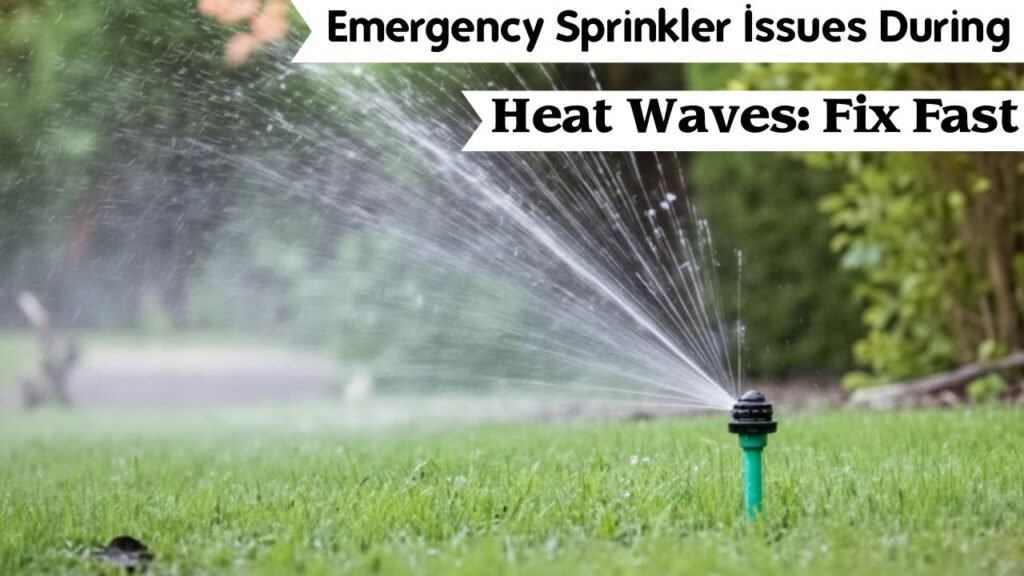
Hydraulic Pressure Drops and the Neighborhood “Window”
During heat waves, most homeowners water early in the morning, creating peak demand from 5:00 AM to 8:00 AM. This Hydrostatic Pressure Drop prevents sprinkler heads from fully extending.
The solution is to shift watering to low-demand periods, such as 11:00 PM to 2:00 AM, when static pressure is highest and heads can operate efficiently. Using a simple pressure gauge at the hose bib can confirm whether your system is underperforming due to insufficient municipal supply.
Soil Science: Hydrophobic Soil and Capillary Action
Extended drought and high heat lead to hydrophobic soil, where water beads and runs off instead of infiltrating the root zone. This phenomenon reduces irrigation efficiency and stresses turfgrass. Professional landscapers combat this using the Cycle-and-Soak Method:
- Run each zone for 7 minutes
- Wait 60 minutes to allow capillary action to pull water downward
- Repeat 3 times
For extreme cases, a soil wetting agent or highly diluted biodegradable dish soap can act as a surfactant to break surface tension, helping water reach roots effectively.
The Master Valve: Identifying the Single Point of System Failure
Many systems include a Master Valve (MV) that controls flow to all zones. If this valve fails—commonly due to heat or solenoid overload—no zones will operate even if the controller appears functional.
Troubleshooting Steps:
- Locate the master valve near the mainline.
- Slowly turn the internal bleed screw to allow water to bypass.
- Activate zones individually to maintain emergency irrigation.
This is a temporary fix but can save critical assets until professional repair.
Emergency Electrical Triage: Solenoids and Controller Heat
Controllers in garages or enclosed cabinets can overheat. If the housing is hot to touch:
- Leave cabinet doors open
- Use a small fan to circulate air
- Monitor transformer voltage to prevent a total blackout
Checking solenoid functionality under thermal load is essential. Humming valves indicate mechanical obstruction; silence suggests wiring failure or broken solenoids.
Nozzle Performance and Soil Penetration
Matched Precipitation and Heat Efficiency
Spray nozzles can lose up to 40% of water to evaporation at temperatures above 100°F. Rotary nozzles or drip irrigation systems reduce this loss to less than 10%.
Swapping nozzles for high-efficiency types (e.g., Rain Bird R-VAN, Hunter MP Rotator) improves wind resistance and ensures even coverage, critical in emergency scenarios.
Watering Priority Matrix: Protect What Matters Most
| Priority | Asset | Notes |
| 1 | Newly Planted Trees/Shrubs | High mortality risk, replace cost $500+ |
| 2 | Established Ornamental Trees | Replacement cost $2,000+, deep watering required |
| 3 | Perennial Garden Beds | Moderate stress, soak carefully |
| 4 | Established Turfgrass | Most resilient, can tolerate delayed watering |
Tree Triage: Targeted Irrigation
For trees, water at the drip line, not the trunk. A slow-release tree watering bag or trickling hose for 2 hours is more effective than running the sprinkler zone for 10 minutes. This method ensures feeder roots receive sufficient moisture.
Cycle-and-Soak: Deep Irrigation Strategy
During extreme heat, water infiltration is limited by soil hydrophobicity. The Cycle-and-Soak Method allows water to gradually reach roots:
- Run zone 7 minutes
- Pause 60 minutes
- Repeat 3 cycles
This method reduces runoff, maximizes soil absorption, and maintains turf hydration without wasting water.
Quick Turf Stress Diagnostic: The Footprint Test
To assess plant stress:
- Walk across the lawn during peak heat
- If grass springs back, it’s manageable
- If grass stays flat with a bluish-gray footprint, the Permanent Wilting Point has been reached
Immediate manual watering is necessary to prevent irreversible damage.
7-Step Emergency Triage Checklist
- STOP: Verify mainline pressure at hose bib
- PRIORITY: Check Master Valve functionality
- Inspect controllers and solenoids for overheating
- Shift watering to 2:00 AM–4:00 AM for hydraulic efficiency
- Cycle-and-Soak all zones in 7-min intervals
- Replace or adjust nozzles for matched precipitation
- Protect high-value trees with drip or slow-release irrigation
FAQ: Rapid Manual Cycling and Hydraulic Shock
Q: Is it safe to rapidly switch zones manually?
A: No. Rapid cycling causes water hammer, damaging pipes and fittings. Allow 10 seconds between zones to stabilize pressure.
Last words:
Heat waves expose every weakness in irrigation systems: electrical, hydraulic, and biological. Immediate action prioritizes high-value assets, mitigates soil hydrophobicity, and ensures minimal plant loss. Emergency irrigation is about physics, timing, and strategy, not routine schedules. Delaying response leads to costly, often irreversible damage.