Flow Testing vs. Visual Inspection: Which One Truly Saves Your Sprinkler System?
Quick Answer:
- Visual Inspection identifies the symptom; Flow Testing identifies the source.
- Visual Inspection is a Symptomatic Check, spotting obvious problems like clogged nozzles or broken heads.
- Flow Testing is a Systemic Audit, measuring Gallons Per Minute (GPM) to uncover hidden issues such as mainline fractures, weeping valve diaphragms, or Subsurface Hydraulic Breaches.
- While visual checks are helpful for routine maintenance, only Flow Testing ensures Volumetric Accuracy, Hydraulic Baseline Calibration, and Non-Revenue Water (NRW) Mitigation.
The Diagnostic Repair Hierarchy
Sprinkler systems are mostly underground—90% of their components are out of sight. That’s why professionals follow a clear hierarchy:
- Visual Inspection (Symptomatic Check): Detects visible problems.
- Flow Testing (Systemic Audit): Measures system performance, identifying hidden issues before they become expensive failures.
By establishing this Diagnostic Repair Hierarchy, homeowners understand that looking at puddles is never enough to confirm system integrity.
Key Entities: Diagnostic precision, irrigation forensics, volumetric flow, systemic health.
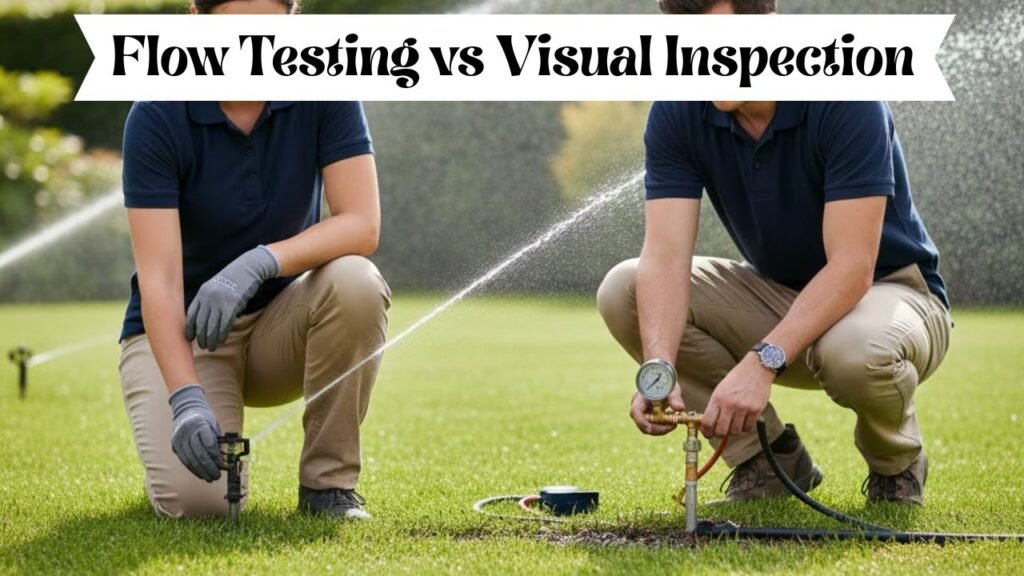
When a Visual Inspection is Enough (and When It Isn’t)
Visual inspections catch obvious signs:
- Broken heads or misaligned risers
- Clogged nozzles or blocked spray patterns
- Shallow lateral line surfacing or donuting (dry rings around heads)
- Mulch, grass, or debris obstructing flow
Limitations:
- Cannot detect leaks under concrete, driveways, or deep soil.
- Fails to detect weeping valves or subtle mainline fractures.
- Misleads homeowners into thinking all is well while Hydraulic Integrity is compromised.
Entities: Nozzle spray patterns, riser height, lateral line surfacing, pop-up seals.
Why Flow Testing is the Only Way to Find “Low-Volume” Leaks
Flow Testing measures the actual water leaving the system and compares it to expected performance.
How Flow Testing Works:
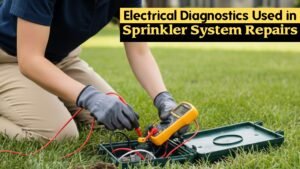
- Use a Digital Flow Sensor or water meter leak indicator.
- Measure baseline GPM for each zone.
- Compare actual GPM to manufacturer specifications or expected Hydraulic Baseline Calibration.
- Identify deviations as small as 1 GPM, which can waste thousands of gallons of NRW annually.
Orifice Equation Logic: Every nozzle has a fixed discharge rate.
- Example: If a zone should pull 10.5 GPM at 40 PSI but your meter shows 12.0 GPM, that 1.5 GPM difference is mathematically a leak, even if the grass looks dry.
Technical Note:
- Friction Loss Calibration: As pipes age, internal scaling increases friction. Flow may drop below specs not due to clogging, but because Coefficient of Friction and Laminar Flow Integrity have changed. A visual check cannot differentiate this from low city pressure.
Entities: Gallons Per Minute (GPM), orifice discharge accuracy, friction loss calibration, hydraulic integrity.
The Low-Flow Sensitivity Gap: Detecting Weeping Valves
Some leaks are subtle:
- Weeping valves allow small, continuous water loss without raising the pop-up stem.
- Causes: Solenoid bleed port failure or valve diaphragm issues.
- Only a Flow Test or triangle leak indicator detects these in real time.
Pro Tip: Minute-Count Method:
- On an analog water meter, observe the red triangle.
- If it completes one rotation in under 60 seconds while all indoor water is off, a Subsurface Hydraulic Breach exists.
Entities: Subsurface hydraulic breach, weeping valve, solenoid bleed port.
Verifying Distribution Uniformity (DU) with Flow and Visual Data
Flow testing alone measures volume. Catch Can Tests validate coverage:
- Visual spray inspection can mislead due to wind drift and evaporation.
- DUlq (Lower Quarter Distribution Uniformity) confirms Matched Precipitation Rates (MPR).
- Combining both ensures uniform watering and prevents dry spots or water waste.
Entities: Scheduling coefficient, DUlq, precipitation rate variance, hydraulic baseline calibration.
Smart Controllers and Advanced Flow Monitoring
Modern controllers like Hunter Hydrawise or Rachio Smart Flow Sensors add automation:
- Allow Flow Variance Thresholds (e.g., 15%).
- Automatically shut off zones exceeding the threshold.
- Detect Air Induction (spikes in GPM) from lateral line breaches, which visual inspections miss.
- Monitor NRW in real time, ensuring immediate response to hidden leaks.
Entities: Flow variance thresholds, hydraulic integrity, air induction, laminar flow integrity.
GPM Math: Translating Flow Data into Real-World Savings
Even minor leaks matter:
- 1 GPM leak wastes ~4,400 gallons per month
- Adds $50–$100 to your monthly water bill
- Causes soil erosion and potential subsurface voids
Pro Tip: Use Hydraulic Baseline Calibration after clearing debris to avoid masking leaks.
Visual vs. Flow: Quick Comparison
| Feature | Visual Inspection | Flow Testing |
|---|---|---|
| Primary Tool | Eyes / Flashlight | Flow Meter / Water Meter |
| Detects | Broken heads, clogged nozzles | Mainline leaks, weeping valves, air induction |
| Accuracy | Low (surface only) | Very High (subsurface, volumetric) |
| Best For | Routine monthly maintenance | Troubleshooting high bills / audits |
| Hidden Cost | Misses $500+ in annual water waste | None; identifies all NRW |
Step-by-Step Diagnostic Protocol
- Clear nozzles and filters via Visual Inspection.
- Conduct Flow Test per zone; record GPM.
- Compare actual GPM with Orifice Discharge Accuracy and baseline.
- Use Catch Can Tests to confirm DUlq.
- Check triangle leak indicator or digital flow for Subsurface Hydraulic Breaches.
- Set smart controller Flow Variance Thresholds to automate alerts.
“Visual Inspection identifies the symptom; Flow Testing identifies the source.”
FAQ: Cost, Value, and Practical Advice
1. Why is my sprinkler leaking but I don’t see water?
Subsurface leaks or weeping valves don’t create puddles. Flow Testing identifies these hidden losses.
2. How do I perform a flow test on a sprinkler system?
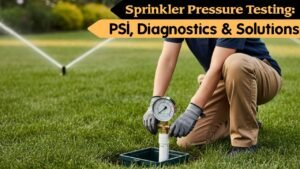
Attach a flow meter, run each zone, and compare actual GPM with expected Hydraulic Baseline Calibration.
3. Is it cheaper to pay for a flow test or just fix broken heads?
Flow tests cost ~$100–$150 but prevent $50+ monthly losses. Visual-only fixes often miss hidden leaks. ROI is realized in 3 months.
4. How do smart flow sensors help?
They provide real-time alerts, detect weeping valves, and ensure NRW Mitigation without manual observation.
Final Verdict
Flow Testing is the forensic standard for irrigation diagnostics. Visual checks are helpful but limited to surface-level symptoms. Integrating Flow Testing, Catch Can DUlq, and Smart Controller monitoring ensures complete system health, NRW Mitigation, and long-term cost savings. For homeowners serious about protecting their landscape and budget, Flow Testing is indispensable.