How Irrigation Technicians Diagnose Them Without Digging Up Your Yard
Hidden sprinkler leaks silently inflate water bills and damage landscapes. Professionals use a forensic three-stage diagnostic protocol: Water Meter Observation with Master Valve Isolation, Acoustic Ground Monitoring with Sonic Leak Localization, and Zone Isolation & Pressure Drop Testing. Advanced methods include Tracer Dyes, Thermal Plume Mapping, and Air Induction Testing. This allows pros to detect leaks as small as 0.1 Gallons Per Minute (GPM) and pinpoint Schedule 40 PVC pipes, weeping valves, or stressed Mainline fittings—preventing unnecessary excavation and expensive trial-and-error repairs.
The Mystery of the “Silent” Leak
Most leaks don’t gush. They seep slowly, creating Non-Revenue Water (NRW)—water that is paid for but never reaches plants. Over time, leaks can:
- Increase hydrostatic pressure against foundations
- Create soil voids through soil piping <span style=”color:green;”>(Visual Cue: look for soft depressions or sudden low spots in your turf)</span>
- Lead to paver collapses or sinkholes
Common culprits include:
- Pinholes in Solenoid valve diaphragms
- Loose or cracked Mainline fittings
- Clogged Atmospheric Vacuum Breakers (AVB)
Detecting these requires diagnostic precision, understanding Laminar vs. Turbulent Flow, and specialized tools.
How Professionals Find Leaks (Step-by-Step)
Step 1: Water Meter Audit – Detecting the Invisible
Techs start at the water meter, inspecting:
- Low-Flow Indicator (Triangle Dial) <span style=”color:green;”>(Visual Cue: small triangular dial inside your meter showing minimal movement)</span>—detects leaks as small as 0.1 GPM
- Odometer Dial—less sensitive, may not move for hours
The Master Valve Bypass Test
If a system uses a Normally Closed (NC) Master Valve:
- Close the Master Valve while monitoring the meter
- If the meter stops, the leak is in the mainline pipe
- If it continues, the leak may be in the service line from the street
This distinction confirms Mainline vs. Service Line leaks before digging.
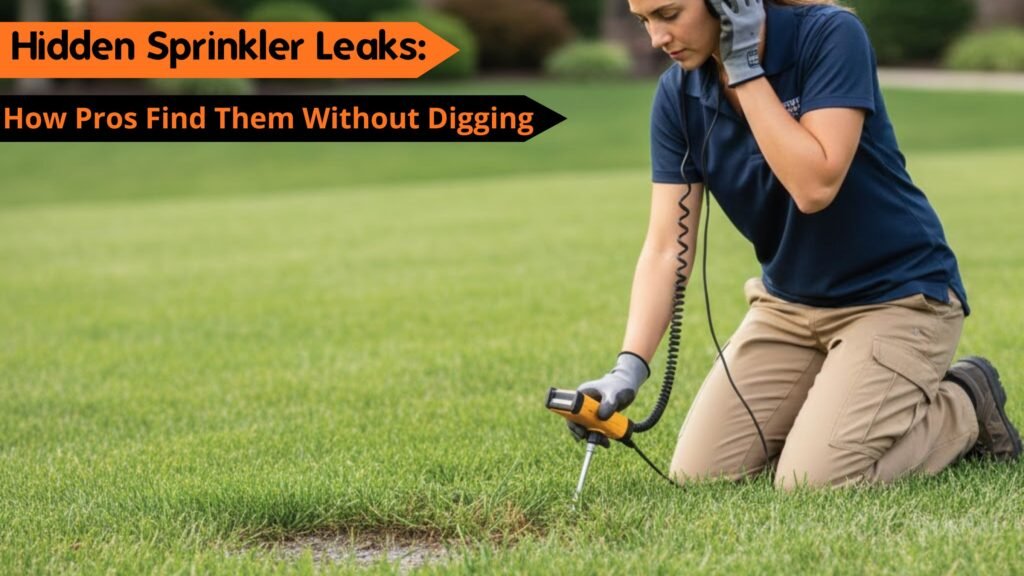
Step 2: How Ground Microphones Hear Leaks Under Driveways and Patios
Acoustic monitoring lets techs “hear” underground water movement. Key details:
- Water escaping pressurized pipes generates a unique frequency between 200Hz–800Hz, called Sonic Leak Localization
- Surface Density Effect: Sound travels faster and clearer through hard surfaces like concrete or asphalt than through loose soil, explaining why leaks under driveways are easier to detect than flower beds
- Weeping Valve Diagnosis: Back-Pressure Imbalance causes the valve to trickle water slowly; blocked bleed ports or pitted valve seats are common culprits
Technical Pro-Tip: Technicians check Solenoid Ohmic Resistance—high resistance often indicates a weak magnetic field causing a “hidden” hydraulic leak.
Step 3: Zone Isolation & Pressure Drop Testing
Techs use inline pressure gauges on Test Cocks or Schrader valves to measure pressure decay:
- PSI drop of 5 lbs in 10 minutes signals a breach
- Observing Water Hammer after rapid zone shutoff can indicate loose fittings about to fail
- Backflow Preventer Test Cocks protect the Public Water Purveyor supply during testing
This step confirms leak location before excavation begins.
Step 4: Using Tracer Dyes and Infrared to Map Subsurface Water Plumes
Some leaks are invisible without chemical or visual tools:
- Fluorescent dye: Shows flow paths in complex pipe assemblies
- FLIR Thermal Imaging: Detects Evaporative Cooling, creating thermal plumes that indicate leak origin
- Plume Mapping visualizes hydrostatic saturation under turf or concrete
This technique reveals leaks beneath lawns, patios, or driveways non-destructively.
Step 5: Compressed Air Diagnostics – Air Induction Testing
For stubborn leaks:
- Drain the line
- Pump compressed air into the pipe
- Listen for high-pitched escaping air
Air is louder and sharper than water, allowing detection through thick clay or deep cover.
Step 6: Mechanical Diagnostics – Inspecting the Diaphragm
Once a suspect valve is identified:
- Inspect Solenoid valve, seat, and diaphragm integrity
- Normally Closed (NC) failures often trickle due to Back-Pressure Imbalance
- Debris flushing and diaphragm replacement prevent recurrent leaks
DIY vs. Professional Toolbox
| Technique | DIY Tool | Professional Tool | Precision |
|---|---|---|---|
| Meter Observation | Analog Meter | Low-Flow Indicator / Triangle Dial | High (System-wide) |
| Acoustic Monitoring | Stethoscope | Ground Microphone / Geophone | Very High (Pinpoint) |
| Pressure Drop Testing | Hand Gauge | Inline Test Cock & PSI Gauge | Moderate (Isolation) |
| Thermal Imaging | None | FLIR Camera + Plume Mapping | Moderate (General Area) |
| Air Induction Testing | Not feasible | Compressed Air Setup | Very High (Difficult Leaks) |
Secondary Impact Warning
Hidden leaks can cause soil piping and voids <span style=”color:green;”>(Visual Cue: look for depressions, soft spots, or sinkholes in turf)</span>, washing away soil beneath driveways or patios. This can result in collapsed pavers or structural issues if ignored. Early detection mitigates these risks.
FAQ: Hidden Sprinkler Leaks
How do you find a sprinkler leak under a driveway?
Acoustic microphones or thermal imaging detect vibration or thermal plumes without breaking concrete.
Why is my water meter spinning when sprinklers are off?
Indicates a Mainline leak or a weeping valve. Triangle low-flow dials detect even tiny leaks.
Can a thermal camera find an underground water leak?
Yes. It maps Evaporative Cooling plumes, revealing subsurface leaks.
Does a leak detection service include repair?
Usually not. Detection and Repair Labor are billed separately.
Does hidden leakage damage soil or landscape?
Yes. Leaks can wash away soil (soil piping) creating voids or sinkholes.
Final Verdict
Hidden sprinkler leaks are a forensic engineering problem, not a simple plumbing issue. Professionals combine meter audits, acoustic monitoring, pressure decay testing, tracer dyes, thermal plume mapping, and compressed air diagnostics to precisely locate leaks. This minimizes excavation, reduces water loss, prevents soil collapse, and protects your landscape and home.