Local vs Franchise Irrigation Companies: Pros and Cons
Choosing between a local vs franchise irrigation company depends on your priorities and landscape complexity. Franchises offer predictable service, corporate-backed warranties, and standardized Smart Controller integration, perfect for homeowners valuing reliability. Local independent contractors provide deep regional expertise, flexible solutions, and nuanced adjustments for soil, sun exposure, and evapotranspiration (ET) rates.
Consider a homeowner in Phoenix, Arizona. Their sprinkler system oversaturated clay beds during winter and under-watered sandy areas during summer. A franchise technician followed SOPs for Matched Precipitation Rates (MPR) but couldn’t account for local soil infiltration.
A local contractor adjusted nozzle serialization, ET-specific watering cycles, and optimized cycle-and-soak schedules. This scenario highlights the critical difference between networked consistency and Site-Specific Optimization.
Local vs. Franchise Irrigation: Key Differences
- Franchises: Standardized training, corporate SOPs, GPS routing, SaaS scheduling, and predictable warranties.
- Local Contractors: Deep knowledge of regional soils, ET, and infiltration rates; personalized communication and flexible solutions.
- Pricing: Franchises often use menu-based flat rates with marketing/royalty fees; locals rely on Time + Materials with potential labor reinvestment.
- Warranties: Franchises offer Warranty Portability; local warranties depend on the shop’s continued operation.
- Inventory & Equipment: Franchises maintain standardized truck stock, whereas locals carry specialized or hard-to-find parts.
What is a Franchise Irrigation Company?
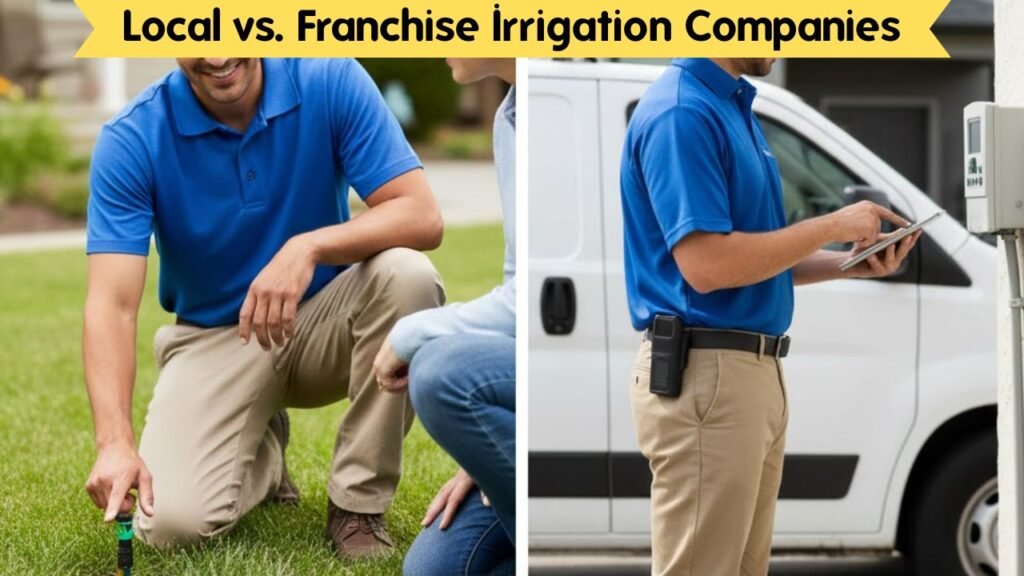
A franchise irrigation company is a nationally branded network that operates on a National Service Model. These companies are often asset-light, relying on SaaS tools for routing, scheduling, and inventory management. Network Effects allow them to source Rain Bird, Hunter, or Toro parts in bulk. Franchises enforce Standard Operating Procedures (SOPs) to maintain consistent MPR and nozzle serialization, ensuring every zone receives the correct GPM.
Pro-Tip: Franchises excel when you need reliable, on-time service, and Warranty Portability that survives business changes.
How Do Local Independent Contractors Differ?
Local contractors provide boots-on-the-ground expertise unmatched by national chains:
- Evapotranspiration & Soil Infiltration: Locals adjust for percolation rates in their region—like Georgia Red Clay vs. Phoenix Sand—for precise watering cycles.
- Custom Hydrozoning: Tailored schedules consider sun exposure, slope, and unique plant needs, achieving superior Site-Specific Optimization.
- Direct Owner Accountability: Homeowners communicate directly with the business owner or lead technician for immediate issue resolution.
Pro-Tip: For custom landscapes, local contractors provide the experience component (E in E-E-A-T) that SOPs cannot replicate.
Are Franchise Irrigation Companies more expensive than Local Contractors?
Franchises may appear pricier due to corporate overhead, marketing fees (7–12%), and SOP enforcement. Local contractors often reinvest that margin into high-grade field labor or pass savings directly to customers.
Hidden Mathematics of Irrigation Pricing:
| Cost Component | Franchise | Local Contractor |
|---|---|---|
| Hourly Labor | $85–$150 | $80–$125 |
| Service Call | $75–$125 | $50–$100 |
| Marketing/Royalty Fee | 7–12% | Often 0% |
| Warranty Support | Corporate Portable | Shop-dependent |
| Inventory | Standardized truck stock | Specialized/hard-to-find parts |
Pro-Tip: Focus on Total Cost of Ownership, not just the upfront price. Franchises may prevent future expenses with Warranty Portability, while locals reduce immediate costs but carry longer-term risk if the business closes.
Emergency Repairs: Franchises can reroute multiple crews via SaaS dispatching for mainline bursts or emergency issues. Local contractors may be tied to a single large installation for days.
Do National Franchises provide better Smart Controller (Rachio/Hunter) integration?
Franchises leverage CRM systems and standardized controller programming to maintain MPR, nozzle serialization, and Hydrozones. Local contractors may manually adjust controllers, providing nuanced adjustments for sun pockets, wind tunnels, and irregular slopes.
Pro-Tip: Franchises guarantee predictable water schedules; locals guarantee Site-Specific Optimization.
Corporate Overhead vs. Local Flexibility
Franchise quotes include:
- Marketing and call center operations
- Standardized training programs
- Fleet maintenance for multiple locations
- SOP enforcement and compliance checks
Local contractors invest in:
- Skilled field labor
- Specialized inventory
- Direct customer service
- Flexible, customized solutions
Pro-Tip: Understanding this breakdown helps homeowners rationalize price differences beyond simple labor rates.
Licensing & Regulatory Compliance
Franchises and local contractors must comply with US state regulations:
- Texas: TCEQ Licensed Irrigators
- California: C-27 Landscaping License
- Florida/Northeast: Backflow certification, annual testing, and seasonal compliance checks
Most municipalities require a BPA Annual Testing Requirement filed with the water purveyor. Franchises often have automatic filing, while local contractors provide paper reports.
Equipment & Vehicle Inventory
- Franchises: Standardized truck stock ensures nearly every repair can be completed in one trip.
- Locals: Specialized inventory focuses on discontinued or hard-to-find parts for legacy systems.
Pro-Tip: Stocking strategy impacts speed and efficiency during peak season.
Warranty Portability & Home Resale
Franchises offer transferable warranties honored by neighboring locations if one branch closes. This paper trail is valuable during home inspections, boosting property value. Local warranties depend on the shop’s ongoing operation.
Pro-Tip: Warranty Portability can save homeowners thousands and adds value for resale.
FAQ Section
Are franchise irrigation companies more expensive than local ones?
Franchises charge more upfront due to SOPs, corporate overhead, and Warranty Portability, but offer predictable service and nationwide support.
Should I hire a local irrigation pro for a custom system?
Yes. For complex slopes, soils, or mixed turf/shrub landscapes, local contractors provide superior Site-Specific Optimization.
Do franchises offer better warranties for sprinkler repair?
Yes. Corporate-backed warranties (1–3 years) are honored across locations; local warranties depend on the shop’s continued operation.
Do I need a permit for sprinkler repairs?
Minor head replacements usually don’t require permits. Mainline or BPA repairs often need municipal approval, included in franchise quotes.
Why do local companies often have longer lead times during peak season?
Without a national call center or multiple trucks, local contractors may book 3–4 weeks ahead. Franchises can scale labor to maintain 48-hour service windows, including emergency repairs.
The Decision Matrix: Which One Are You?
- Choose a Franchise if: You want a 48-hour service window, standardized billing, transferable warranty, and predictable scheduling.
- Choose a Local Independent if: You have complex landscapes, unique soil challenges (like heavy salt or extreme clay), or prefer to support small businesses.
Final Verdict
Selecting between a local or franchise irrigation company balances Consistency vs. Regional Expertise. Franchises provide SOPs, corporate-backed Warranty Portability, and predictable Smart Controller integration. Local pros offer deep regional knowledge, Site-Specific Optimization, and flexible service for unique conditions.
Pro Tip: Prioritize Total Cost of Ownership over initial price. Evaluate warranties, licensing, inventory, and emergency service capabilities to ensure your irrigation system thrives for years.