Introduction: Sprinkler System Inspection Checklist
In July 2024, a homeowner in Austin, Texas noticed a soft, muddy patch near their back patio. At first, it looked harmless. By August, the monthly water bill had tripled. By September, a structural engineer confirmed soil washout beneath the slab, followed by a $12,000 foundation repair.
The root cause was not dramatic or visible. It was a $5 lateral line crack made of PVC Schedule 40, leaking underground for months. The system had passed a visual “walk-through” inspection earlier that spring.
This scenario explains why a professional sprinkler system inspection is not a casual checklist. It is a technical irrigation audit designed to identify hydraulic, electrical, and compliance failures before they turn into property damage.
For US homeowners navigating rising water costs, stricter municipal enforcement, and modern smart controllers, this guide explains exactly what a professional-grade inspection includes and why it matters.
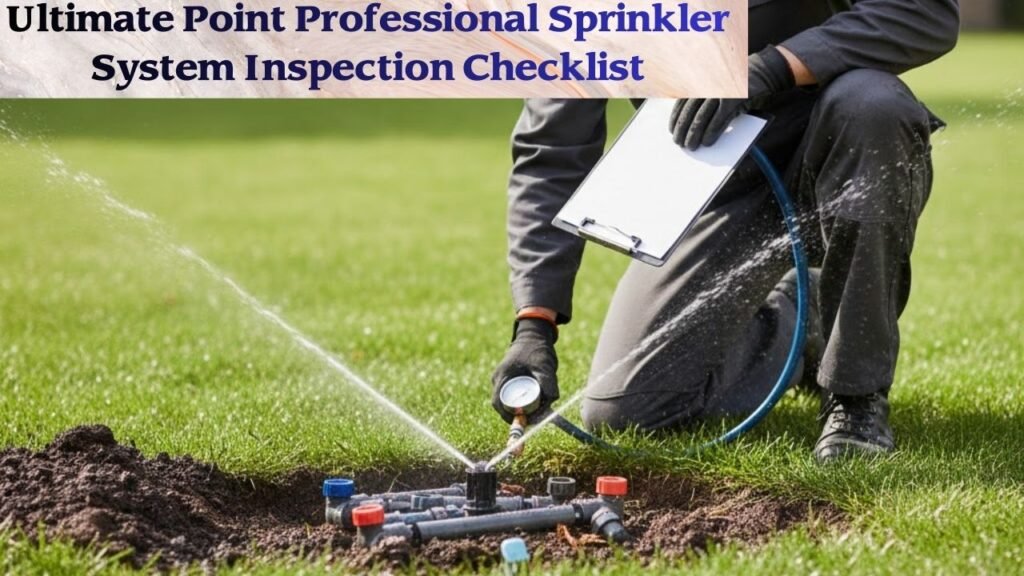
The 15-Point Professional Sprinkler Audit Checklist
Below is the same structured audit sequence used by licensed irrigation contractors and EPA Water Sense partners. This list appears early because homeowners want clarity before detail.
- Controller Power & Transformer – Confirm stable voltage and proper operation.
- Backup Battery – Test memory retention during outages.
- Seasonal Adjust & Cycle/Soak – Verify program settings match turf type and soil.
- Rain & Moisture Sensors – Ensure irrigation shuts off during rainfall.
- Backflow Assembly Type – Identify PVB or RPZ device installed.
- Backflow Compliance – Confirm state and municipal certification is current.
- Static Pressure – Measure PSI at mainline for supply evaluation.
- Dynamic Pressure – Measure PSI at each operating sprinkler head.
- Valve Box Inspection – Check for leaks, standing water, or debris.
- Solenoid & Wiring Test – Measure resistance and common wire continuity.
- Lateral Line Check – Inspect for subsurface leaks and soft spots in turf.
- Spray Body & Riser Audit – Evaluate pop-up heads, tilt, and neck seal leaks.
- Nozzle Cleaning & Alignment – Clear clogged rotary/fixed sprays and correct overspray.
- Catch Can DU Test – Measure water distribution uniformity across the zone.
- Documentation & ROI – Record deficiencies, water loss, and potential repair savings.
This is not a DIY walkthrough. It is a diagnostic framework.
Auditing Controller Logic and Electrical Integrity
Why it matters:
The irrigation controller governs runtime, sequencing, and conservation behavior. Even the most efficient hardware fails when programming logic is incorrect. Many water-waste violations originate at the controller, not the sprinkler head.
How professionals audit it:
An inspection begins by testing transformer output with a multimeter to ensure proper voltage delivery. Weak transformers often cause intermittent solenoid activation, leading to zones that partially open or fail to close. Backup batteries are tested next, since memory loss after power outages frequently resets schedules to factory defaults.
Professionals then review advanced programming features on EPA WaterSense-labeled controllers, such as Hunter Pro-HC or Rachio. Key functions include Seasonal Adjust percentages and Cycle and Soak, which breaks long runtimes into shorter watering cycles to prevent runoff on compacted soils or slopes.
Grass type also affects programming. Cool-season grasses like Kentucky Bluegrass and Tall Fescue demand higher spring and fall water volumes. Warm-season grasses like Bermuda and St. Augustine peak during summer and require different seasonal curves. Incorrect assumptions here quietly inflate bills.
Pro-Tip (Controller Audit):
If runoff occurs within the first five minutes of watering, reduce runtime and enable Cycle and Soak before adjusting nozzle flow.
Calibrating Hydraulic Pressure and Backflow Protection
Why it matters:
Hydraulic imbalance causes misting, overspray, and accelerated wear. Meanwhile, improper backflow protection creates health and legal risks.
Backflow prevention in the US:
Professionals identify the installed assembly type during inspections. Most residential systems use either a PVB (Pressure Vacuum Breaker) or an RPZ (Reduced Pressure Zone) device. RPZ assemblies are required for high-hazard systems, including those with fertilizer injectors or well water connections.
States such as California, Texas, and Florida enforce strict Cross-Connection Control programs. Many municipalities require annual certified testing and documentation.
Pressure measurement standards:
Static pressure is measured with no water flowing to assess supply strength. Dynamic pressure is measured while a zone operates, which reflects real-world conditions.
Residential Pressure Standards
| Measurement | Professional Standard | Failure Threshold |
|---|---|---|
| Static Pressure | 40–60 PSI | >80 PSI (Regulator Required) |
| Dynamic Pressure | 30–50 PSI | >50 PSI at head (Efficiency Loss) |
PRS heads and dynamic pressure control:
When dynamic pressure exceeds 50 PSI at the head, professionals recommend retrofitting with Pressure-Regulated Stem (PRS) spray bodies. Models like the Rain Bird 1800-PRS maintain a constant 30 PSI at the nozzle, producing optimal droplet size and reducing evaporation and misting.
Pro-Tip (Pressure Audit):
Always measure pressure at the head, not just the mainline. Losses and spikes often occur downstream.
Conducting a Zone-by-Zone Mechanical and Electrical Audit
Why it matters:
Most costly irrigation failures hide underground or inside valve boxes. Visual surface checks miss them.
How professionals inspect zones:
Every valve box is opened. Standing water often indicates a leaking diaphragm or cracked valve body. Solenoids are tested with a multimeter. A healthy solenoid typically reads 20–60 Ohms. Readings above this range suggest an open circuit or failing coil.
If multiple zones fail simultaneously, professionals test common wire continuity. An “Open” reading usually indicates a severed wire, often caused by aeration, trenching, or root intrusion.
Lateral lines are inspected indirectly by walking turf and identifying soft or saturated soil. Underground PVC Schedule 40 cracks rarely surface immediately but steadily erode soil.
Sprinkler heads are inspected closely. Professionals look for sunken heads, tilted risers, clogged rotary nozzles, and especially leaking neck seals, which can lose up to 0.5 GPM without visible spray issues.
Pro-Tip (Zone Audit):
If grass grows faster around one head, suspect a neck seal leak even if spray looks normal.
Measuring Distribution Uniformity with the Catch Can Test
Why it matters:
Uniform water distribution determines whether runtimes hydrate plants or waste water. Poor uniformity forces longer cycles and higher bills.
How professionals perform the test:
- Place identical containers evenly across the zone.
- Run irrigation for a fixed, timed cycle.
- Measure water depth in each container.
To calculate Distribution Uniformity (DU), professionals average the lowest 25% of readings and divide by the overall average. A DU of 0.70 or higher meets professional standards. Lower scores indicate poor spacing, pressure imbalance, or nozzle mismatch.
Troubleshooting Reference Table
| Symptom | Likely Cause | Professional Solution |
|---|---|---|
| Misting | Excess pressure | PRS heads or regulators |
| Dry patches | Poor spacing | Head realignment |
| Runoff | Long runtimes | Cycle and Soak |
| Constant seepage | Worn seals | Replace spray bodies |
Pro-Tip (DU Testing):
Always test after pressure corrections. DU results are meaningless if PSI is unstable.
Aligning Audits with Seasonal Maintenance and Water Budgeting
Why it matters:
Climate and season determine failure risk and water demand.
Winterization standards:
Professional blowouts require 50–100 CFM, not just high PSI. High air volume moves water out of low points. Small homeowner compressors often fail to clear loops and low spots, leading to freeze expansion and pipe bursts.
Spring startup and water budgeting:
In warmer regions, spring audits restore pressure balance and update schedules. Professionals group landscapes into Hydrozones, ensuring high-water turf zones do not share circuits with drought-tolerant shrubs. Audits often align runtimes with Maximum Applied Water Allowance (MAWA) targets used in professional certifications.
Pro-Tip (Seasonal Audit):
If winter damage appears in the same zone each year, suspect insufficient CFM during blowout.
Expert FAQ
Does my municipality require a certified backflow test for a residential sprinkler system?
Many US cities require annual testing, especially in California, Texas, and Florida. Requirements vary by municipality and backflow type.
What does a professional sprinkler inspection cost in the US?
Most professional audits range from $100 to $300, depending on system size and compliance testing needs.
Is a professional sprinkler audit worth the return on investment?
Yes. Audits frequently pay for themselves within one season through reduced water bills and avoided repairs.
Can smart controllers replace a professional inspection?
No. Controllers manage schedules but cannot detect leaks, wiring failures, pressure imbalance, or backflow violations.
Final Verdict
A professional sprinkler system inspection is a comprehensive irrigation audit, not a visual walkthrough. It integrates hydraulics, electrical diagnostics, backflow compliance, and water budgeting to protect both property and water resources.
Homeowners who follow this checklist gain efficiency, legal compliance, and long-term system reliability. For anyone serious about water savings and risk prevention, this inspection framework is the place to start—and a strong reason to explore professional services further.