Retrofit vs New Sprinkler Installation: Which Makes Sense for Your Property?
Homeowners usually face this decision after years of rising water bills, uneven coverage, or repeated repairs. At that stage, the question is not about convenience. The real issue is whether the existing irrigation system still has usable infrastructure value or whether it has crossed into economic liability. The correct answer depends on measurable engineering indicators, not visual condition or past spending.
This guide explains how to evaluate that decision using cost thresholds, hydraulic performance, and system lifespan metrics.
Executive Summary: Retrofit or Replace?
A sprinkler retrofit makes financial sense only when the underground piping and wiring retain sufficient structural and electrical integrity. In professional evaluations, the break-even point occurs when modernization costs remain below 30% of the cost of full replacement, and the system shows no signs of systemic hydraulic or electrical failure.
Systems older than 25–30 years often exceed their Asset Lifecycle Index, meaning internal pipe roughness, material fatigue, and wiring corrosion increase long-term operating risk. When repair frequency rises or diagnostics show declining performance, full replacement becomes the more cost-effective solution over a 20-year horizon.
The Economic Break-Even Point Explained
Every irrigation system follows a depreciation curve similar to other buried infrastructure. Early upgrades deliver strong returns. Late-life upgrades accelerate failure.
A retrofit is justified when:
- Underground pipe maintains pressure without repeated leaks
- Hydraulic delivery supports current flow demand
- Electrical resistance remains within safe limits
Replacement becomes unavoidable when:
- Repairs approach 25% of replacement cost
- Pipe age exceeds expected service life
- Flow limitations prevent modern nozzle performance
Ignoring this threshold leads to sunk-cost spending rather than asset optimization.
When a Sprinkler Retrofit Makes Sense
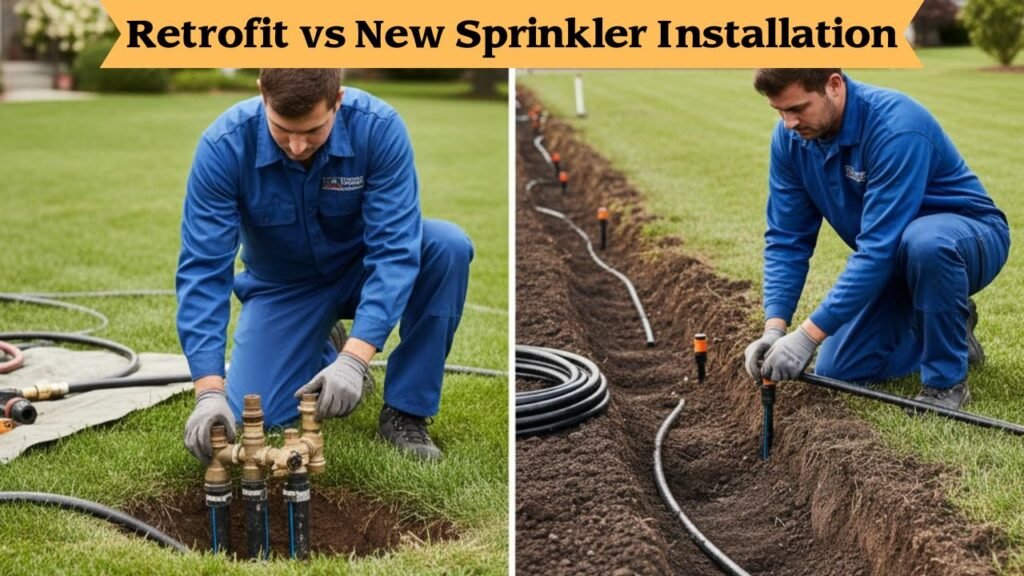
A retrofit works best when the existing underground infrastructure remains hydraulically sound and correctly sized. In these cases, surface upgrades dramatically improve efficiency without excavation.
Ideal conditions for retrofitting include:
- Schedule 40 PVC mainline and laterals
- Zones aligned with current lawn layout
- Stable pressure with no recurring mainline leaks
- Wiring that passes electrical continuity testing
Typical retrofit upgrades involve:
- Smart ET-based irrigation controllers
- Pressure-regulated spray heads
- High-efficiency rotary nozzles
- Rain and freeze sensors
These upgrades improve Distribution Uniformity (DU), reduce overspray, and lower operating costs without disturbing landscaping.
Why Retrofits Cannot Fix Low-Pressure “Weeping” Zones
Misting and weeping are often confused but stem from different hydraulic issues. Misting results from excess pressure and is easily corrected with pressure regulation. Weeping indicates insufficient flow delivery.
As PVC ages, internal mineral buildup and biofilm increase pipe roughness. This reduces the pipe’s C-Value, limiting gallons per minute delivery even when no leaks exist. The result is Dynamic Flow Starvation, where modern rotary nozzles fail to fully extend or rotate.
Systems built with SDR-21 thin-wall pipe or undersized laterals often reach this limitation earlier. No controller or nozzle upgrade can overcome insufficient hydraulic capacity. Only pipe replacement restores proper velocity head.
Pipe Materials and Hydrostatic Shock Cycles
Pipe material directly impacts system longevity. Older residential systems frequently used SDR-21 thin-wall pipe, which tolerates fewer pressure fluctuations. Each valve closure generates a pressure surge. Over decades, these hydrostatic shock cycles fatigue thin-wall pipe.
Schedule 40 PVC offers thicker walls and stronger solvent-weld Molecular Fusion, allowing it to absorb pressure changes without cracking. Retrofitting advanced hardware onto weakened thin-wall pipe often accelerates failure rather than preventing it.
Electrical Diagnostics: The Ohmic Resistance Test
Electrical integrity plays a critical role in retrofit viability. Modern Wi-Fi controllers require stable current delivery to operate reliably.
Professional wiring diagnostics include:
- Measuring Solenoid Continuity at the controller
- Acceptable resistance range: 20–60 Ohms
- Unsafe readings: 100+ Ohms
High resistance indicates galvanic corrosion in splices or wire runs. This forces controllers to push higher current, generating heat that shortens electronic lifespan. Installing a new controller on degraded wiring risks early failure, making a full wire replacement the safer option.
Smart Controllers and Predictive Water Savings
The real return on a retrofit comes from intelligence, not hardware alone. Smart controllers use local weather data to calculate evapotranspiration and soil moisture loss.
These systems apply:
- Landscape Coefficient (Kₗ) adjustments
- Predictive Hydration Modeling
- Cycle-and-soak watering logic
They account for Hygroscopic Pull, preventing runoff while maintaining plant health. Compared to static timers, these controllers reduce water usage by up to 40% under proper conditions.
The 25% Rule: Calculating Your Replacement Threshold
This rule simplifies decision-making. When cumulative repairs and upgrades exceed 25% of the cost of a new installation, replacement becomes the financially superior choice.
Below this threshold, retrofitting preserves capital and improves efficiency. Above it, continued upgrades increase risk and long-term cost.
Cost Comparison: Retrofit vs New Installation
| Metric | Retrofit | New Installation |
|---|---|---|
| Upfront Cost (CapEx) | $500–$2,000 | $4,000–$10,000+ |
| Operating Cost (OpEx) | Moderate reduction | Maximum efficiency |
| Asset Lifespan | Dependent on pipe age | 20–25 years |
| Hydraulic Performance | Limited by existing pipe | Fully optimized |
| Resale Documentation | Minimal | Full as-built blueprint |
Does Replacement Add More Property Value?
A new sprinkler system provides documented infrastructure. Installers supply an as-built irrigation blueprint showing pipe routes, valves, and wiring. Home inspectors treat this as a transferable capital improvement.
A retrofit improves performance but usually lacks full documentation. For buyers, mapped infrastructure reduces uncertainty and increases perceived value.
Final Professional Verdict
Retrofits deliver strong ROI when underground assets remain structurally and electrically sound. Replacement becomes the rational choice when hydraulic capacity, wiring integrity, or lifecycle limits are exceeded. The smartest decision always comes from diagnostics, not appearance.
Homeowners who evaluate systems using engineering thresholds avoid overspending and protect long-term property value.