Pressure Testing a Sprinkler System: What the Results Mean
A residential sprinkler system works best between 40–65 PSI (Pounds per Square Inch). Static Pressure measures potential energy, while Dynamic (Working) Pressure shows the system’s actual performance. A pressure decay over 5 PSI in 10 minutes during a static test often signals a Mainline Leak.
Drops in dynamic pressure indicate Friction Loss, pipe restrictions, or a fouled Backflow Preventer Assembly (BPA). Correct interpretation prevents wasted water, premature component failure, and hidden structural issues.
Using a Static Pressure Test to Find Underground Mainline Leaks
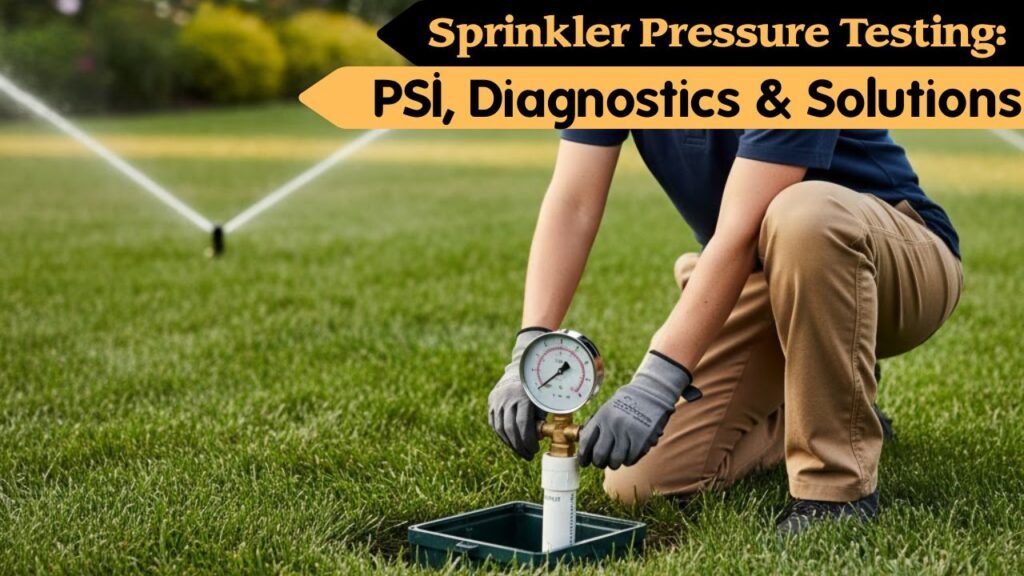
Static testing evaluates system integrity. Steps:
- Attach a pressure gauge to a hose bib or BPA Test Cock.
- Allow 60 seconds for the Static Stabilization Period—air pockets and Thermal Expansion can initially fluctuate readings.
- Record the initial reading, then monitor for 10–15 minutes.
Pro Tips:
- Valve Bypass Diagnostic: If pressure decay only occurs when the Master Valve is open, the leak is in the Mainline. If decay occurs even when the Master Valve is closed, the leak lies in the service line between the meter and the Master Valve.
- Observe the Low-Flow Indicator on your water meter—it can detect leaks as small as 0.1 GPM.
- Consider elevation: every foot rise decreases pressure by 0.433 PSI (Elevation Head Loss). Example: a 10-foot rise = ~4.3 PSI drop.
This forensic approach prevents digging in the wrong place and targets the true source of hidden leaks.
Why Dynamic Pressure Drops When Your Sprinklers Turn On
Dynamic pressure testing evaluates water delivery under operational load. Factors include:
- Friction Loss: Water loses pressure along pipes; pipe age and roughness matter. The Hazen-Williams Equation uses the C-Value to quantify this. New PVC has a C-Value of 150, while old galvanized steel drops to 60–80, explaining massive dynamic pressure drops even without leaks.
- Velocity Surge: High flow velocity can mist water or reduce Distribution Uniformity (DU).
- Pump Systems: If pressure cycles during a dynamic test, check Pump Pressure Switch and Pressure Tank Bladder rather than pipes.
Professional Tip: Measure pressure at the nozzle using a Pitot Tube to confirm Working Pressure, which is critical for correct orifice flow.
Interpreting the Results: The Red Flag Chart
| Pressure Reading | Status | Symptom | Required Action |
|---|---|---|---|
| 0–30 PSI | Critically Low | Heads won’t pop; poor coverage | Inspect for leaks, pump issues, or BPA restrictions |
| 40–65 PSI | Ideal | Uniform spray; healthy seals | Standard maintenance |
| 70–80 PSI | High | Minor misting; diaphragm stretching | Install PRS heads & Pressure Regulator |
| 85+ PSI | Dangerous | Misting clouds; pipe bursts; diaphragm overstretch | Reduce Working Pressure, install regulators |
Note: While Static Head may read 70 PSI, your Working Pressure (Dynamic) determines nozzle performance. A gap >25% between the two signals Friction Loss or flow restrictions.
How to Isolate a Backflow Pressure Drop
To identify a fouled BPA:
- Take a reading at Test Cock #1 (inlet).
- Take a reading at Test Cock #4 (outlet).
- A drop >10 PSI indicates a fouled check valve or broken spring.
Key Entities: Pressure Differential, Inlet vs. Outlet Pressure, Pounds per Square Inch (PSI).
This step differentiates pipe leaks from device restrictions with professional precision.
The Impact of Topography on PSI
Elevation changes affect water delivery:
- 0.433 PSI per foot: Every foot of vertical rise reduces pressure by 0.433 PSI.
- A backyard 10 ft above the water meter sees ~4.3 PSI lower readings.
- Not every drop is a leak—physics governs Elevation Head Loss.
The Role of the Backflow Preventer in Pressure Loss
A fouled BPA creates a bottleneck:
- Pressure drops across Double Check Valves (DCV) or Reduced Pressure Zone (RPZ) assemblies reduce dynamic performance.
- These drops impact Orifice Flow and Matched Precipitation Rates (MPR).
Physics & Engineering Insights
- Friction Loss reduces pressure along pipes; diameter, roughness, and age matter.
- Pressure Regulated Stems (PRS) cap head pressure at 30–45 PSI to maintain coverage.
- Dynamic Surge and high velocity can atomize water; low Working Pressure causes uneven coverage.
- Pro-level testing incorporates Coefficient of Friction and Pressure Differential for precise diagnostics.
FAQ: Sprinkler Pressure Testing
What is normal pressure for a home sprinkler system?
40–65 PSI is ideal. Variations indicate leaks, friction loss, or fouled BPA.
Why did my sprinkler pressure drop suddenly?
Possible causes: mainline leak, friction loss, failing BPA, city water fluctuations.
How do I test my mainline for leaks?
Use a Static Pressure Test with 10–15 minute monitoring. Compare Master Valve open vs closed.
Why did my sprinkler pressure go UP during a static test?
Thermal Expansion in a closed system, often combined with a Check Valve Lock, can raise PSI by 5–10 lbs. The pressure has nowhere to escape, confirming system integrity.
Does a high Static Head always mean good performance?
No. Your Working Pressure (Dynamic) dictates nozzle spray. Check for gaps >25% to detect restrictions or friction losses.
Final Verdict
Understanding both Static Head and Working Pressure gives homeowners a forensic roadmap of sprinkler system health. By factoring Friction Loss, Elevation Head, Thermal Expansion, and BPA Pressure Drop, you can identify hidden issues before they damage landscapes or components. Accurate pressure testing saves water, extends system life, and prevents expensive repairs.