Why One Missed Step in Fall Can Cost You Thousands in Spring
Every fall, thousands of U.S. homeowners shut down their sprinkler systems believing they’ve done enough to protect them from winter. The controller is turned off. Air comes out of the heads.
Everything looks dry. Yet when spring arrives, the system fails in expensive and frustrating ways. Cracked mainlines, broken backflow preventers, and warped valve manifolds are common outcomes.
The reason is simple but often misunderstood. Sprinkler systems do not fail because winter is cold. They fail because water was left behind, and that water went through repeated freeze-thaw cycles.
Each cycle causes expansion, contraction, and material fatigue. Over time, even brass and Schedule 40 PVC will crack under that stress.
True winterization is not about blowing air randomly through pipes. It is about controlled moisture evacuation, done with the correct equipment, sequence, and understanding of irrigation physics.
The Physics of Air Volume: Why PSI Alone Does Not Protect Your Pipes
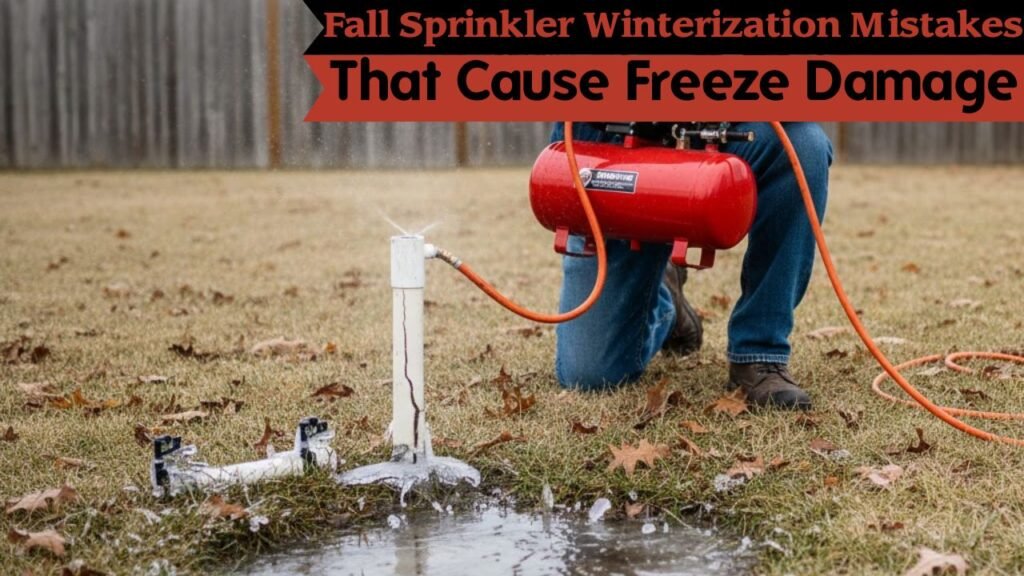
The most common and destructive winterization mistake is confusing air pressure (PSI) with air volume (CFM). Pressure creates force, but volume is what actually moves water through pipe dips, elevation changes, and long mainline runs.
Most homeowner compressors produce high pressure but very low airflow. A typical shop compressor may reach 100–125 PSI but deliver only 2–4 CFM.
That air compresses over water instead of pushing it out, leaving pockets trapped in low sections of the system. These pockets freeze first and cause longitudinal splitting in pipes.
Professional irrigation contractors rely on high-volume compressors because they can lift water out of low points without creating damaging friction.
High CFM allows air to displace water evenly, which is the only reliable way to prevent freeze damage.
Thermal Fatigue and Friction Heat: Damage That Shows Up Months Later
Another overlooked error is running air through the system for too long. When pipes are already dry, fast-moving air creates friction heat. Over time, this heat softens PVC, weakens glued joints, and accelerates thermal fatigue.
This damage is rarely visible immediately. Pipes often survive winter, then crack during spring startup when water pressure returns. That delayed failure makes the original winterization mistake hard to trace.
Professional guideline:
- Never run air through a dry zone for more than 2 minutes
- Allow at least 5 minutes of cooling time between cycles
Pipe Materials Matter More Than Most DIY Guides Admit
Not all irrigation piping behaves the same during freezing conditions.
- Schedule 40 PVC is commonly used for mainlines. It is rigid and strong but unforgiving under expansion stress.
- Class 200 PVC and Polyethylene (Poly) are typically used for lateral lines. They offer flexibility, but that flexibility has limits.
While Poly pipe itself may flex, the insert fittings, clamps, elbows, and tees do not. These rigid points concentrate stress and are the first places cracks appear. Assuming Poly systems are “freeze-proof” is a costly misconception.
The Backflow Preventer Mistake That Leads to $600–$1,000 Repairs
The Pressure Vacuum Breaker (PVB) is the most vulnerable component in the entire system. Internally, it contains plastic check valves, rubber poppets, springs, and seals. These parts are designed for water flow, not compressed air.
A major DIY error is introducing air through the backflow preventer or connecting to the test cocks. High-velocity air creates friction that damages internal components, leading to leaks, stress fractures, or complete failure. Worse, a damaged backflow preventer can allow potable water contamination through siphon age.
Professional standard:
- Introduce air downstream of the backflow device
- Leave backflow ball valves at a 45-degree angle for winter
Oil Contamination: The Silent Long-Term Failure
Many homeowners use oil-lubricated air compressors without realizing oil mist travels with compressed air. That oil settles on rubber components throughout the system.
Affected parts include:
- Valve diaphragms
- Solenoid seals
- Sprinkler head O-rings
Petroleum-based oils cause rubber to swell and degrade over time. The system may appear fine in spring but develop leaks, sticking valves, or failed heads during the season.
Expert rule: If using an oil-lubricated compressor, a coalescing oil filter is mandatory.
Valve and Solenoid Errors: When Water Never Leaves the Zone
Cold temperatures can stiffen valve components, especially the solenoid diaphragm. If a valve does not fully open during winterization, water remains trapped downstream, regardless of how much air is applied elsewhere.
Professionals never rely solely on the controller. They manually verify valve operation by:
- Turning the solenoid by hand
- Opening the bleed screw
- Confirming movement at the diaphragm seat
Skipping this step leaves entire zones unprotected.
Vacuum Lock and Indoor Bleed-Back: A Step Most DIYers Miss
Many systems include an indoor irrigation shut-off valve with a bleed cap. If this cap is not opened, a vacuum lock can trap water in the vertical riser pipe leading outside.
Even after a proper blowout, that trapped water can freeze and split the pipe.
Correct procedure:
- Place a bucket under the indoor valve
- Open the bleed cap
- Open outdoor test cocks to break the vacuum
DIY vs. Professional Blowout: Risk vs. Reward
| Option | Typical Cost | Equipment | Risk Level |
| DIY Blowout | $0–$50 | Small shop compressor | High |
| Professional Service | $75–$150 | 185+ CFM tow-behind | Low |
A single cracked mainline or backflow replacement can exceed $2,500. Many insurance policies do not cover preventable freeze damage caused by improper winterization.
The Professional Winterization Sequence (Checklist)
- Shut off water at the stop-and-waste valve
- Open indoor bleed cap to relieve pressure
- Connect air after the backflow preventer
- Regulate pressure (50 PSI PVC / 80 PSI Poly)
- Cycle each zone multiple times with cooling periods
- Drain backflow and set valves to 45 degrees
- Turn controller to Off or Rain Mode
Final Word: Winterization Is Applied Physics
Winterization is the only time of year when an irrigation system is completely exposed to physics. Water expands. Materials fatigue. Small errors compound silently over months of freezing and thawing. If you cannot guarantee high-volume airflow, clean air delivery, and fully drained protection components, the money saved on a DIY job is often just a down payment on a spring disaster.