How Weather Extremes Impact Sprinkler Longevity
A Monday morning reality check often starts with a shock: a sky-high water bill and patches of dead turf. The homeowner assumed the system would run flawlessly all season, but a few forgotten maintenance tasks, combined with extreme environmental stressors, can accelerate component failure.
Understanding how heat waves, freezes, soil shifts, and drought affect sprinkler materials is crucial. By integrating scientific concepts like Coefficient of Thermal Expansion, Hydrostatic Stress, and Evapotranspiration (ET) Rates, homeowners can extend system life and avoid costly repairs.
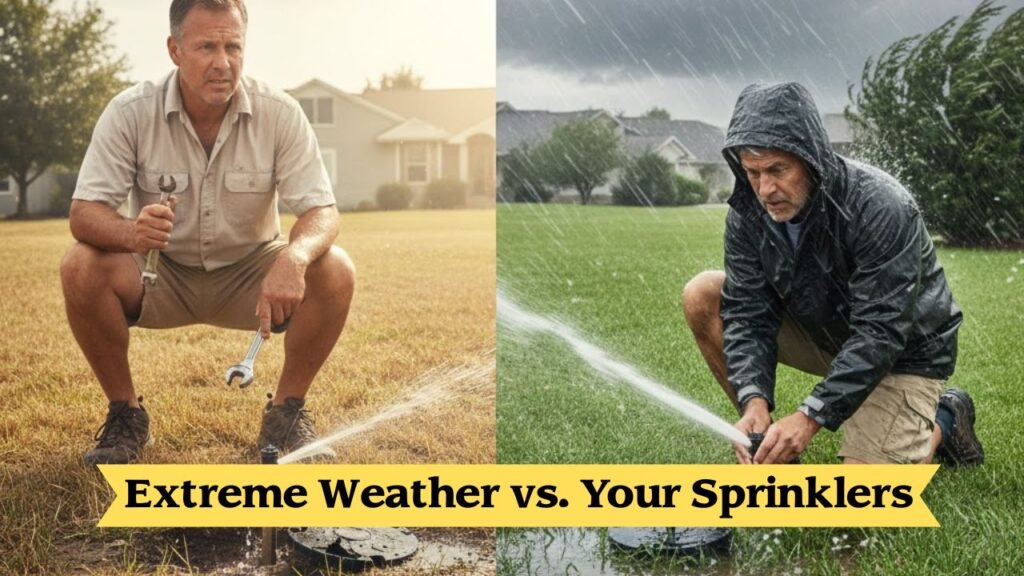
Summer Extremes: UV Radiation, Thermal Fatigue, and PVC Expansion
High summer temperatures and direct sunlight create significant stress on PVC piping and rotor heads. PVC has a high Coefficient of Thermal Expansion, meaning a 100-foot lateral line can elongate over an inch when ambient temperatures rise from 60°F to 100°F.
If the line is constrained by rigid fittings or compacted soil, this thermal growth generates shear stress, which can pull pipe joints out of cement bonds and cause leaks.
- Rotor Heads (Hunter PGP, Rain Bird 5000): Gear-driven heads experience mechanical creep, where torque gradually shifts the left and right arc stops. Homeowners should manually verify turret alignment at the season’s start to avoid overspray on hardscapes.
- PVC Pipes: UV exposure breaks down polymer chains, leaving surfaces brittle and susceptible to cracking. Misting at heads may indicate internal spring fatigue.
- Valve Diaphragms: Heat and Ozone Degradation attack unsaturated carbon bonds in rubber, leading to Compression Set. Valves may “weep” or fail to close entirely, creating invisible water loss.
Winter Freeze-Thaw: The Ice Lens Phenomenon
A single night at 31°F can damage backflow preventers, mainlines, and swing risers. Water expands roughly 9% upon freezing, forming an ice lens in tight tolerances of Pressure Vacuum Breakers (PVBs).
This expansion can warp the internal spider assembly, causing the unit to fail ASSE 1013 certification, even if no visible leak appears.
- PVC Mainlines: Repeated freeze-thaw cycles stress joints, leading to micro-fractures.
- Swing Pipes / Risers: Flexible couplings absorb lateral movement from soil contraction.
- Diurnal Temperature Swing (H3): The difference between daily maximum and nighttime minimum creates a “bellows effect” that fatigues PVC glue bonds. In high-desert or plains climates, a 50°F swing is common, causing repeated expansion and compression on pipe joints.
Drought and Soil Shifting: Silent Stress on Components
When soil dries, especially clay-heavy soils, lateral stress on buried pipes causes stress cracks at fittings. Shrinking soil pulls at PVC and mainline risers, sometimes subtly enough that homeowners misinterpret it as “normal aging.”
- Solution: Install swing pipe couplings to allow vertical and horizontal movement.
- Micro-Climate Audit: Identify Radiant Heat Zones near south-facing walls or concrete surfaces. Sprinkler heads here can experience 30°F higher temperatures than open turf, accelerating UV-induced embrittlement and seal failure.
Electrical Triage: Heat-Stressed Solenoids
High ambient temperatures impact copper wiring by increasing electrical resistance, which leads to voltage drops. For every 10°F rise, the resistance increases, potentially dropping voltage below 18VAC.
When this happens, solenoids may hum without actuating, causing a zone failure on smart controllers such as Rachio or Hunter Hydra wise.
- Visual Indicators:
- Faded LCD display or reset clock → battery corrosion
- Faded LCD display or reset clock → battery corrosion
- White mineral crust on wires → solenoid or connector corrosion
Hydraulic Shock: Water Hammer During Drought
Drought-induced municipal pressure drops can introduce air pockets into the mainline. When the system activates, these pockets create Hydraulic Shock, striking elbows or closed valves at high velocity. This surge can exceed 500 PSI—double the burst rating of standard Schedule 40 PVC.
- Prevention: Gradual zone startup and Pressure Regulated Stems (PRS), such as Rain Bird 1804-PRS, reduce high-pressure spikes.
- Observation: Misting or fogging at heads is a sign of high static pressure and indicates the need for PRS upgrades.
Material Longevity Table
| Component | Weather Threat | Expected Lifespan | Actionable Protection Strategy |
| PVC Mainline | Thermal expansion, soil shifting | 7–10 yrs (vs 20 yrs ideal) | Deep burial, swing risers, monitor glue joints |
| Rotor Heads | UV exposure, mechanical creep | 5–7 yrs | Manual turret checks, PRS UV-stabilized heads |
| Valve Diaphragm | Heat, ozone degradation | 3–5 yrs | Annual pressure relief, replace compressed diaphragms |
| Backflow Unit | Freeze, ice lens | Immediate risk | Insulate hot box, fall blowout, ASSE 1013 compliance |
| Solenoids / Wiring | Heat, resistance rise | 5–10 yrs | Monitor voltage, replace corroded wire nuts, grease DBY connectors |
7-Step Professional Audit Checklist
- Inspect Rotor Arc Stops: Prevent mechanical creep and overspray.
- Check PVC Glue Joints: Look for shear stress damage from thermal expansion.
- Examine Valve Diaphragms: Identify Compression Set from ozone exposure.
- Test Solenoids: Ensure voltage >18VAC under heat load to prevent zone failures.
- Conduct Micro-Climate Audit: Identify Radiant Heat Zones and adjust ET-based schedules.
- Assess Backflow Assemblies: Verify no ice lens formation after winter, maintain ASSE 1013 compliance.
- Pressure Regulation: Upgrade to PRS heads if misting occurs or static PSI exceeds design limits.
By understanding the Coefficient of Thermal Expansion, Ice Lens Phenomenon, Ozone Degradation, Hydraulic Shock, Diurnal Temperature Swing, and Micro-Climate Effects, homeowners can implement a predictive maintenance strategy that significantly extends sprinkler system longevity.
Conducting these inspections and adjustments regularly prevents invisible water loss, catastrophic component failure, and ensures optimal lawn health in extreme climates.
Conclusion
Extreme weather accelerates sprinkler system wear through mechanical, thermal, and chemical stressors. By understanding Coefficient of Thermal Expansion, Ice Lens formation, Ozone Degradation, Hydraulic Shock, and Diurnal Temperature Swings, homeowners can take proactive steps to protect their investment.
Regular audits, pressure regulation, micro-climate assessments, and timely component replacements not only extend system lifespan but also prevent costly water waste and repairs. A strategic, science-based maintenance plan ensures your irrigation system remains resilient against both heat waves and freezes.