Why Some Sprinkler Repairs Fail Repeatedly: A Professional Root Cause Analysis
Recurring sprinkler failures are rarely caused by poor workmanship alone. In most cases, the repair fails because the underlying mechanical, hydraulic, or environmental stressors were never identified or corrected. This article explains why sprinkler repairs fail repeatedly and outlines the systemic causes responsible for chronic breakdowns in residential and commercial irrigation systems across the U.S.
Root Cause Analysis Summary
Repeated sprinkler failures indicate Systemic Irrigation Failure, not isolated component damage.
Systemic failure occurs when hydraulic forces, soil instability, or electrical degradation exceed the tolerance of repair materials. In these conditions, replacing a damaged part addresses the symptom—but leaves the system environment unchanged. As a result, the repair fails again within months.
The most common contributors include:
- Excessive water velocity
- Pressure surge events
- Unsupported piping due to soil loss
- Improper solvent welding
- Moisture migration within electrical wiring
Until these forces are controlled, repairs remain temporary.
Hydrostatic Shock and the 5-FPS Velocity Rule
Professional irrigation engineering limits water velocity to 5 feet per second (FPS). Exceeding this threshold introduces destructive pressure forces that standard repairs cannot withstand.
Why velocity matters:
- High-velocity water carries increased kinetic energy
- Sudden valve closure converts energy into pressure spikes
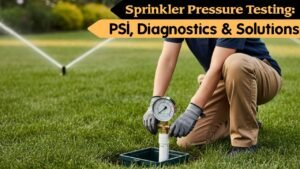
- Pressure can rise up to four times the system’s static PSI
Failure patterns caused by excessive velocity:
- Repeated pipe fractures near valves
- Fittings separating despite proper glue application
- Chronic leaks that reappear after replacement
Without effective Hydrostatic Shock Mitigation, even high-quality repairs fail prematurely.
Why Sprinkler Pipes Break in the Same Location
When a sprinkler pipe fails repeatedly in the same spot, the issue is almost always structural.
How soil voids develop:
- A small leak erodes fine soil particles
- Water movement creates an underground cavity
- The pipe loses bedding support and becomes suspended
Engineering consequences:
- Flow transitions from laminar to turbulent
- Pipe vibration increases
- External abrasion accelerates failure
This vibration phenomenon—known as Vortex Shedding—causes the pipe to grind against surrounding material until a stress fracture occurs. Without restoring Subsurface Bedding Stability, replacement piping will fail again.
Momentum Vector Forces and Thrust Block Failure
Water exerts measurable force when changing direction inside a pipe. This force is known as a Momentum Vector.
Where failures occur most often:
- 90-degree elbows
- Tees and manifolds
- Directional changes near valves
What happens without thrust restraint:
- Hydraulic force pushes the fitting outward
- Soil displaced by earlier leaks provides no resistance
- The solvent-welded joint slowly separates
Installing thrust blocks transfers this energy into undisturbed earth, preventing joint migration and long-term failure.
Solvent Welding Errors and Solvent Entrapment
PVC solvent cement is not adhesive—it creates molecular fusion between pipe and fitting. When this process is rushed or improperly executed, structural integrity is compromised.
Common solvent welding mistakes:
- Skipping primer
- Using fast-set cement on large-diameter pipe
- Pressurizing before full cure time
Solvent Entrapment risk:
- Trapped solvent continues to weaken pipe walls
- Internal pressure ratings permanently decline
- Failure occurs weeks or months later under normal operation
Proper Interference Fit Integrity requires full cure time, especially in cold weather.
Electrical Moisture Migration and Solenoid Failure
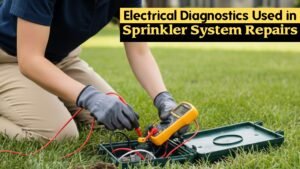
Electrical failures are often misdiagnosed as faulty solenoids when the true issue lies in wiring.
How moisture damages wiring:
- Copper strands attract water through hygroscopic pull
- Moisture travels via capillary action inside insulation
- Corrosive minerals increase resistance over time
Resulting system issues:
- Weak solenoid activation
- Intermittent zone operation
- Premature solenoid burnout
Effective Capillary Wicking Prevention requires waterproof connectors and dielectric protection at every splice.
Thermal Expansion and Seasonal Pipe Failure
PVC expands and contracts with temperature changes. Repairs performed during extreme heat or cold must account for this movement.
Seasonal stress factors:
- Tight installations during summer expand beyond tolerance
- Winter contraction creates longitudinal tension
- Stress concentrates at glued fittings
Over time, this leads to delayed cracking known as Longitudinal Stress Fractures, often mistaken for material defects.
Symptom vs. Root Cause Breakdown
| Symptom Observed | Typical Fix | Actual Root Cause | Permanent Correction |
|---|---|---|---|
| Pipe keeps breaking | Slip coupling | High velocity | Pressure regulation |
| Valve leaks again | Diaphragm replacement | Pressure surge | Velocity control |
| Zone won’t activate | New solenoid | Moisture migration | Sealed splices |
| Joint separates | Re-gluing | No thrust restraint | Concrete thrust block |
| Seasonal cracking | Pipe replacement | Thermal stress | Expansion allowance |
Professional Evaluation Checklist
Before authorizing a repair, verify the following:
- Water velocity has been measured and controlled
- Soil bedding has been restored and compacted
- Thrust blocks are installed at directional changes
- Solvent-weld cure time was fully observed
- Electrical splices are sealed against moisture
If these steps are not addressed, the repair is not permanent.
Conclusion
Sprinkler repairs fail repeatedly because system forces are ignored. Hydraulic energy, soil instability, thermal movement, and electrical moisture migration must be managed—not bypassed.
Replacing parts without correcting conditions is not repair. It is postponement.
Permanent irrigation reliability comes from engineering discipline, not repeated component replacement.