Introduction: Why This Problem Keeps Repeating
Property managers usually discover this issue after paying to fix the same irrigation failure twice. At that point, the problem is no longer a broken pipe or valve. The problem is the repair itself. Incorrect irrigation repairs introduce hidden structural and hydraulic weaknesses that quietly increase operating costs year after year. This article explains, in practical terms, how incorrect repairs increase long-term irrigation costs and why those costs accelerate instead of stabilizing.
Hydraulic Technical Debt: The Real Cost of a “Cheap Fix”
Every sub-standard irrigation repair creates Hydraulic Technical Debt. This debt behaves like financial debt with compounding interest. The interest shows up as repeat labor, water loss, and premature system aging.
Incorrect repairs increase long-term irrigation costs by:
- Increasing Non-Revenue Water (NRW) through slow leaks
- Creating new stress points that fail under normal pressure
- Shortening the effective service life of the entire system
Once this debt accumulates, even correct future repairs become more expensive because the system has already lost structural stability.
Mechanical Repairs vs. Molecular Fusion Joints
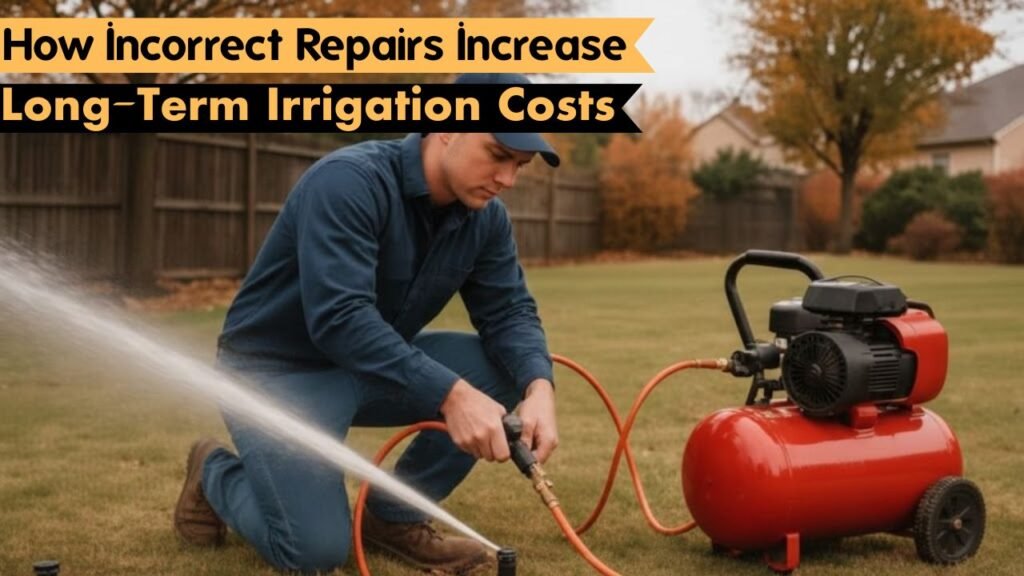
One of the most common repair mistakes involves pipe joining methods. Budget repairs rely on compression fittings or push-fit couplings. These methods depend on friction, not chemistry.
Professional repairs use solvent welding that creates Molecular Fusion through Cross-Link Polymerization. This process turns two pipe sections into one continuous structure.
Cost impact comparison:
- Mechanical coupling: flexible, vibration-sensitive, short lifespan
- Molecular fusion joint: rigid, pressure-stable, full lifecycle durability
Incorrect joining methods multiply long-term irrigation costs by guaranteeing future failures at the same location.
Improper Backfilling and Structural Bedding Failure
Incorrect repairs often fail months later due to poor trench restoration. When native rocky soil is placed directly against a pipe, it creates Point Loading.
As the system cycles, vibration causes Mechanical Impingement. Over time, this produces shear stress that thins the pipe wall until rupture occurs.
Key consequences include:
- Subsurface Void Formation from soil washout
- Pipe snapping under normal soil weight
- Repairs costing up to five times more than early detection
This failure is not random. It is engineered by improper backfilling.
Hydraulic Rebound and Cascading Failures
Incorrect repairs also disrupt system balance. Restrictive fittings or mismatched pipe sizes create pressure bottlenecks.
When water hits these restrictions, it produces a shockwave known as Hydraulic Rebound. That energy travels backward and breaks the next weakest joint.
This explains why:
- A second leak often appears within days
- Failures migrate instead of stopping
- Each repair increases system instability
This cascading effect is a primary reason incorrect repairs increase long-term irrigation costs across large properties.
Electrical Shortcuts and Controller Failure
Electrical negligence turns small savings into large capital losses. Using standard wire nuts allows moisture intrusion, which increases Solenoid Ohmic Resistance.
Higher resistance causes voltage drop. The controller compensates by increasing output, which raises transformer temperature. Over time, this heat destroys the logic board.
A common cost chain looks like this:
- $5 wiring shortcut
- Increased resistance and heat load
- Controller failure
- $800–$1,500 replacement cost
This failure mode is silent until it becomes expensive.
Financial Impact on Operating Costs and NOI
From a financial perspective, incorrect repairs increase long-term irrigation costs by accelerating depreciation and inflating operating expenses. Repeat failures increase labor costs, raise water bills, and shorten the usable life of the system.
Over a ten-year horizon, properties with repeated incorrect repairs experience:
- Higher OPEX volatility
- Reduced Net Operating Income (NOI)
- Earlier CAPEX replacement cycles
In most forensic audits, the cumulative cost of re-repairs exceeds the cost of doing the work correctly the first time.
Conclusion: Why Doing It Right Is Cheaper
Incorrect irrigation repairs do not save money. They delay costs, multiply failures, and quietly drain asset value. Understanding how incorrect repairs increase long-term irrigation costs allows property managers to stop financing repeat failures and start protecting system lifespan, budgets, and NOI by choosing forensic-grade repairs from the start.