Low water pressure in sprinklers is frustrating. One week the lawn looks fine. Next week, heads barely pop up and dry patches show everywhere. In most cases, the fix is not expensive. But only if you diagnose it correctly. This guide shows how to troubleshoot low water pressure in your sprinklers, using the same step-by-step logic professionals follow. No guessing. No unnecessary digging. Just clear checks that tell you when it’s a simple DIY fix and when it’s something bigger.
Action → Result
Always start with these. They solve more problems than people expect.
- Check the meter yoke → Confirm the main shut-off valve is 100% open
Result: A partially closed valve can reduce pressure by 30% or more. - Toggle the backflow ball valves → Turn handles until perfectly parallel to the pipe
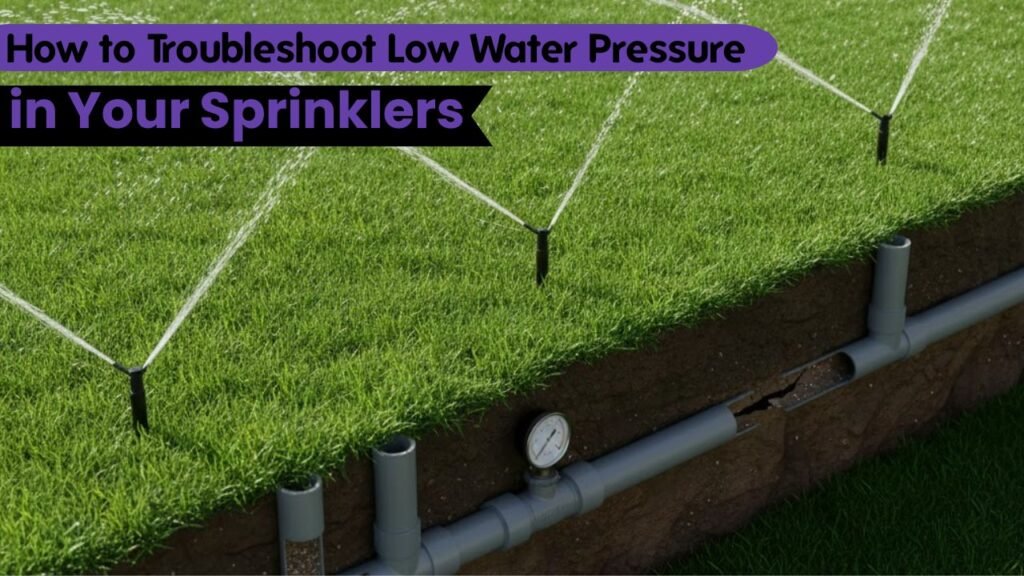
Result: Even a slight angle creates a major PSI drop. - Run the “geyser test” → Turn on a zone and watch for bubbling or pooling water
Result: Bubbling means a broken line underground. - Inspect the last head in the zone → Remove the nozzle from the head furthest from the valve
Result: Strong flow here means a clogged nozzle, not a pipe leak.
If pressure improves at any step, stop. You found the cause.
What Is Normal Water Pressure for Sprinklers?
Most residential sprinkler systems work best at 30–50 PSI (Pounds per Square Inch) at the heads. When pressure is low, the problem almost always falls into one of two buckets:
- Pressure restriction (valves, backflow device, clogged filters)
- Volume loss (leaks, undersized pipe, failing supply)
Understanding this difference saves time and money.
Pressure vs. Volume: Which One Is Missing?
This is where many homeowners get stuck.
- Pressure (PSI) is the speed of the water
It’s affected by partially closed valves or pressure regulators. - Volume (GPM) is the amount of water available
It’s affected by leaks, pipe size, and supply limits.
Think of PSI as speed and GPM as lane count. You need both.
Visual Diagnostic Comparison
| Symptom | Missing Pressure (PSI) | Missing Volume (GPM) |
|---|---|---|
| Head behavior | Heads barely pop up | Heads pop up but spray short |
| Sound | Quiet or whistling | Hissing or air spurting |
| Coverage | Uneven rotation | Weak distance everywhere |
| Likely cause | Closed valve/regulator | Leak or undersized piping |
How to Test Your Home’s Water Flow Rate
This test adds real numbers to your diagnosis.
What You Need
- A 5-gallon bucket
- A stopwatch or phone timer
How to Do the Test
- Attach a hose to a spigot near the irrigation tie-in.
- Turn water on fully.
- Time how long it takes to fill the bucket.
The Math
GPM = 300 ÷ seconds to fill 5 gallons
Critical Benchmark
If your supply is below 6–10 GPM, your system will never support 5 or more rotor heads in one zone, no matter how high the PSI looks. This one number explains many pressure complaints.
How to Check the Water Source Before Digging
Before touching the irrigation system, confirm the supply itself.
- Utility-fed water:
Pressure drops often happen after maintenance when the meter valve isn’t reopened fully. - Pump-fed systems:
A failing pump or pressure tank bladder shows normal static pressure, then collapses when zones run.
If hoses also feel weak, stop here. The problem is upstream.
Backflow Preventer Troubleshooting
Backflow devices quietly cause pressure loss. Common units include Febco, Watts, and Wilkins pressure vacuum breakers (PVB).
Step-by-Step Backflow Check
- Confirm both handles are fully parallel.
- Listen while a zone runs.
Important diagnostic clue:
If the PVB makes loud vibrating or chattering noises, the internal poppet and bonnet may be stuck. This creates a massive internal pressure drop even when the valve looks open.
Never bypass a backflow preventer. It protects drinking water from contamination. Improper handling can create serious health and code issues.
Why Only One Zone Has Low Pressure (The Solenoid Secret)
If just one zone struggles, focus on the valve box.
Inside every valve:
- A diaphragm controls flow.
- A solenoid opens the valve electrically.
- A manual bleed screw allows manual operation.
Common problems:
- Torn diaphragms that “weep” pressure.
- Solenoids not opening fully.
- Bleed screws left partially open.
Any of these steals pressure without visible leaks.
How to Diagnose Leaks Without Digging
Watch the Water Meter Leak Indicator
This is a simple but powerful test.
- Turn off all water inside the house.
- Watch the small triangular leak indicator on the water meter.
If it spins, you have a mainline leak between the meter and irrigation valves.
Mainline vs. Lateral Symptoms
| Symptom | Likely Cause |
|---|---|
| All zones weak | Mainline leak or backflow issue |
| One zone weak | Lateral leak or clogged head |
| Heads leak when off | Failed valve diaphragm |
Pipe Material Matters More Than You Think
- PVC pipe usually cracks.
You’ll see soggy soil or a visible geyser. - Poly or Blue Lock pipe can kink without breaking.
Flow is restricted with no wet spot at all.
This difference explains many “invisible” pressure problems.
Advanced Pressure Loss Most Systems Ignore
Static vs. Dynamic Pressure
Static pressure looks fine when nothing runs. Dynamic pressure drops when zones activate. That gap points to volume loss, not pressure supply.
Friction Loss From Small Pipe
Using ½-inch pipe instead of 1-inch over long runs creates severe friction loss. The last head always suffers first.
Elevation Head Loss
Water loses about 4 PSI for every 10 feet of elevation gain. Uphill heads will always struggle unless zones are designed correctly.
Spray Heads vs. Rotor Heads (Mismatch Problems)
Mixing head types kills pressure.
- Pop-up spray heads: High PSI, low GPM
- Rotor heads: Higher GPM demand, lower PSI tolerance
many pressure issues are solved by switching to high-efficiency rotary nozzles like Hunter MP Rotators or Rain Bird R-VAN, which require far less GPM while maintaining full coverage.
Smart Controllers Can Mimic Low Pressure
Controllers like Hunter Pro-C, Rain Bird ESP-Me3, and Orbit B-hyve don’t create pressure, but wiring problems can limit valve opening. Diagnostic step:
- Use a multimeter at the controller.
- Healthy solenoid reading: 20–60 Ohms
- Higher readings mean wiring resistance, not pressure loss.
This is often misdiagnosed.
How to Flush Debris to Instantly Restore Flow
Before replacing parts:
- Remove the nozzle from the furthest head.
- Run the zone briefly.
- Flush sand, dirt, and plastic debris.
Also inspect:
- Filter screens
- O-rings
- Valve inlet screens
Debris causes more pressure loss than broken parts.
DIY vs. Call a Pro (Clear Line)
DIY Makes Sense When
- Opening valves
- Cleaning heads and filters
- Replacing solenoids or diaphragms
- Adjusting nozzles or regulators
Call a Pro When
- Locating hidden mainline leaks
- Replacing backflow preventers
- Using acoustic leak detection
- Installing booster pumps
Pros don’t guess. They measure.
Final Thoughts
Low sprinkler pressure feels urgent because it is. But most fixes are logical, measurable, and affordable when diagnosed properly. Start at the source. Follow the water. Use numbers, not guesses. That’s how you fix pressure problems without tearing up the yard.