Sprinkler leaks show up in two ways. One is loud. Water spraying everywhere. You see it and panic a bit. The other is quiet. The lawn looks dry, but the water bill keeps creeping up. That silent leak is the one that causes the most damage over time. This guide is built to fix both problems. Fast. It follows the same isolation-first method professionals use, so you don’t dig random holes all over the yard. You’ll find the leak, confirm it, and fix it with confidence. No guessing. No wasted effort. I’ve worked around irrigation systems and repair content for decades. The pattern never changes. Leaks are easy to solve when you follow a process.
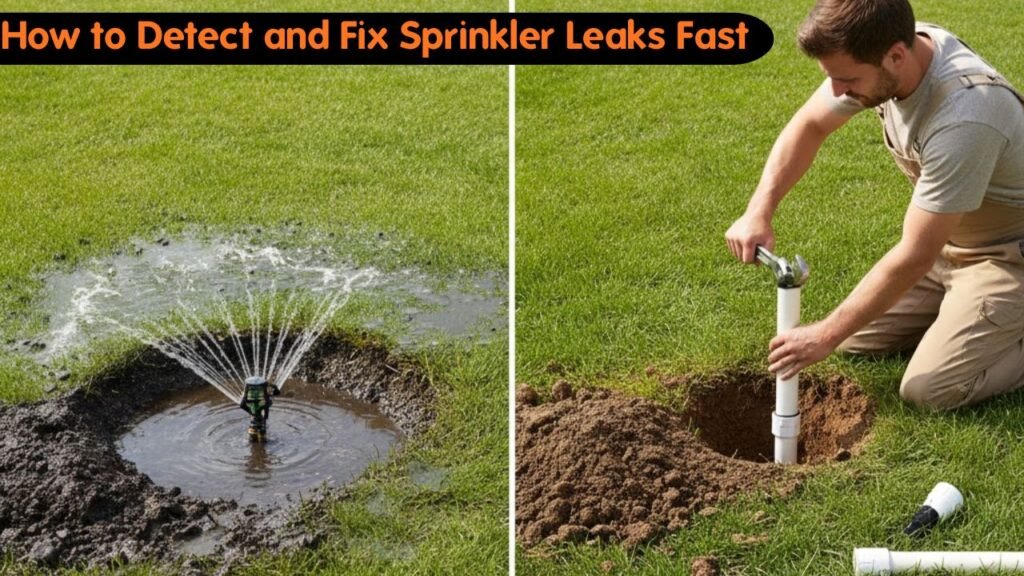
How Do I Know If My Sprinkler System Is Leaking?
Start here. This answers the main question quickly.
The 3-Step Leak Isolation Test
- The Water Meter Test
Turn off all indoor water. Every faucet. Toilets. Ice maker too. Go to your water meter and watch the leak indicator (small triangle or star).- If it spins nonstop, you have a main line leak.
- If it stays still, move to Step 2.
On modern meters, look for a flashing (+) plus sign or faucet icon. If the screen shows flow in GPM while all fixtures are off, the irrigation system has a live leak. Pro-Tip:
If there’s no visible indicator, write down the meter reading. Wait 20 minutes without using water. If the number changes, there’s a leak. Simple test. Works every time. - The Zone Test
Run each sprinkler zone manually.- Meter spins only during one zone? Leak is in that zone’s lateral line.
- Meter spins during every zone? Look at the valve manifold.
- The Visual Scan
Walk the yard while the suspect zone runs. Look for:- Bubbling soil
- Pooling water
- Low head pressure
This test alone solves most leak mysteries.
Quick Leak Identification Table
| Symptom | Likely Leak Location | Severity |
|---|---|---|
| Meter spins 24/7 | Main line / master valve | High (Emergency) |
| Meter spins only in one zone | Lateral line | Medium |
| Water “weeps” after shutoff | Low head drainage | Low |
| Geyser during operation | Broken sprinkler head | Low |
This table narrows things fast.
What Is Sprinkler Leak Detection?
Sprinkler leak detection is the process of identifying constant flow from a main line leak or pressure loss within a specific zone caused by a lateral line leak. Early detection prevents soil saturation, foundation risk, erosion, and excessive water utility costs.
Is the Leak Live or Scheduled?
This distinction matters more than anything else.
Main Line Leak (Live Leak – 24/7)
Main lines sit under static pressure all day.
Signs
- Water flows even when the timer is off
- Meter shows constant flow
- Soil stays wet
A leak near the Point of Connection (POC) is the highest priority. If the shut-off valve itself is failing, water can bypass your controls completely.
A 1-inch main line can lose 30–50 GPM. That’s thousands of gallons an hour.
Lateral Line Leak
Lateral lines only pressurize when a zone runs.
Signs
- Leak appears during one zone
- Pressure drops in that zone
- Heads barely pop up
These are common and usually DIY-friendly.
How to Detect Hidden Sprinkler Leaks
Once you know the type, narrow the exact spot.
Precision Meter Watching
- Slow indicator movement = seepage
- Fast spin = rupture
This tells you urgency.
Pressure Gauge Test
Attach a gauge to a hose bib or riser.
- Pressurize system
- Shut it off
- Watch PSI
If pressure drops fast, there’s a leak. Most systems run 30–50 PSI.
Read the Lawn
Plants tell the truth.
- Greener patches
- Mushy soil
- Faster growth downhill
Leaks follow gravity. Always.
Common Leak Locations and What They Mean
Valve and Manifold Leaks
Valve boxes hide slow failures.
Check for:
- Loose solenoids
- Worn diaphragms
- O-ring seepage
Pro-Diagnostic Tip:
Shut off the irrigation isolation valve. If the meter stops but the valve box stays soggy, you likely have a seeping diaphragm or cracked manifold header.
Cracked PVC Pipes
Freezing, soil movement, and water hammer cause splits.
Telescoping Repair Coupling (Slip-Fix):
A Telescoping Repair Coupling is a fitting that expands and contracts, letting you bridge a cut pipe without bending PVC or stacking elbows. It’s one of the easiest underground DIY fixes.
Weeping Sprinkler Heads
This causes confusion. Low Head Drainage is gravity, not pressure.
- If water stops leaking 10–15 minutes after shutdown, it’s drainage.
- If it never stops, it’s a leaking valve.
Fix drainage with heads that include built-in check valves (SAM).
Fixing a Broken Underground Pipe
STOP: Call 811 before you dig. Even shallow sprinkler work can hit buried gas or power lines. It’s free, and it’s required. Now proceed.
Locate and Excavate
- Hand dig near pipes
- Expose at least 6 inches on each side
Cut and Clean
- Square cuts
- Deburr edges
- Wipe dry
Dry Fit
- Test alignment
- Confirm spacing
Flush the Line
- Turn water on for 5 seconds
- Blow out dirt and shavings
Solvent Weld
- Use Purple Primer (code-required in many areas)
- Apply primer and cement to pipe and fitting
- Push and hold 10 seconds
Use only Schedule 40 ASTM D2466 pressure-rated fittings. Never use DWV parts.
Cure time rule:
Wait 30 minutes before testing. Wait 2 hours before full pressure if temps are below 60°F.
Why Silent Leaks Are Dangerous
In areas with expansive clay soils, leaks near slab-on-grade foundations cause soil swelling and concrete cracking. A $50 pipe fix can prevent a $20,000 foundation repair. This is why fast detection matters.
Preventing Future Sprinkler Leaks
Leaks are usually symptoms.
- Regulate pressure
- Use PRS heads
- Winterize correctly
- Replace brittle swing pipe (funny pipe)
Prevention always costs less.
How much water does a leaking sprinkler head waste?
Up to 1,000 gallons per month if it runs 15 minutes, three times a week. A main line leak can lose that much in one hour.
Can a sprinkler leak cause a sinkhole?
Yes. Constant pressurized flow erodes soil below the surface. Spongy turf or sudden dips mean shut off water now.
How do I find a leak if there’s no water on the surface?
Use a soil probe or long screwdriver. Push it into the ground along the pipe path. The spot where it sinks easily is your saturated hot spot.
Final Thoughts
Finding sprinkler leaks fast isn’t about tools. It’s about isolation. Start at the meter. Separate main line from lateral line. Narrow it zone by zone. Then dig once, not five times.