If your sprinkler zone won’t turn on, won’t turn off, or acts weird only sometimes, the solenoid is usually the first suspect. And for good reason. The solenoid is the hardest-working electrical part in the entire irrigation system. It clicks on and off thousands of times over its life. Homeowners usually land here with three questions in mind. How long do sprinkler solenoids last? How do I know mine is failing? And do I replace just the solenoid or the whole valve? This guide answers those questions directly, without fluff. It’s written from years of real-world troubleshooting, not theory.
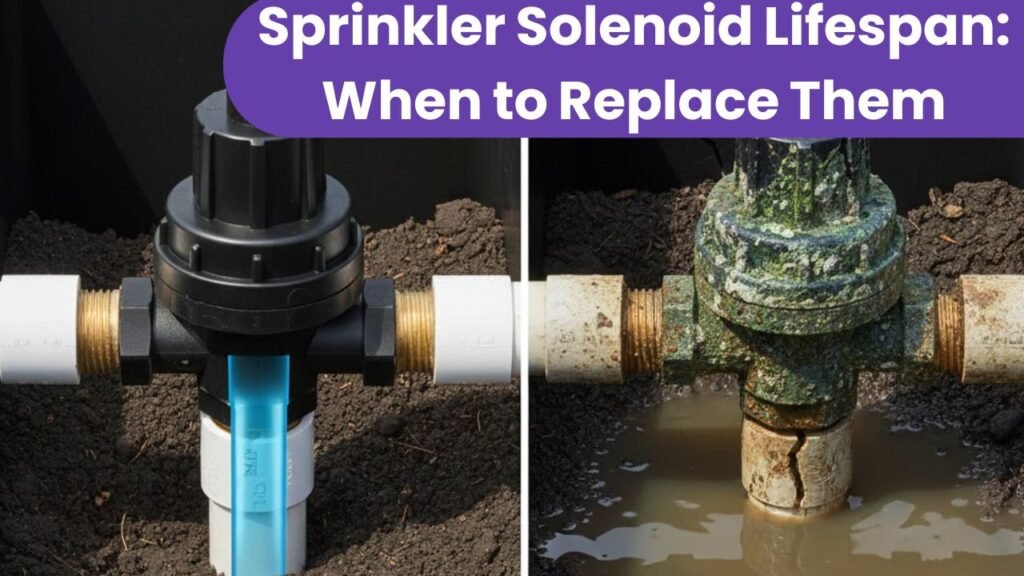
Sprinkler Solenoid Lifespan
| Specification | Typical Range |
|---|---|
| Estimated Lifespan | 10–15 years (normal conditions) |
| 3–5 years (hard water / lightning exposure) | |
| Voltage Requirement | 24–28 VAC |
| Normal Resistance | 20–60 Ohms |
| Replacement Difficulty | Easy (2/10) |
If your solenoid falls outside these ranges, it’s already living on borrowed time.
What Is a Sprinkler Solenoid and Why It Fails First
A sprinkler solenoid is an electromagnetic switch. When the irrigation controller sends 24VAC, the solenoid coil creates a magnetic field. That field lifts a stainless steel plunger against a small internal spring. Once lifted, water pressure opens the valve diaphragm and the zone runs. When power stops, the spring pushes the plunger down. The valve closes.
Important distinction:
- Solenoid = electrical trigger
- Valve body & diaphragm = hydraulic parts
They age differently. Most “bad valves” are really tired solenoids.
The Anatomy of Failure: Why Solenoids Stop Working
Solenoid lifespan is controlled by two internal parts.
The Plunger
The plunger slides inside a narrow tube. Over time, minerals in the water leave scale. Calcium and iron create friction. The plunger still moves, but slowly or unevenly. That’s when buzzing starts.
The Spring
Springs lose tension memory. After 10+ years, the spring may not fully reseat the plunger. The valve may stay partially open. This leads to zones that won’t shut off cleanly. In many cases, the electrical coil is fine. The mechanics aren’t.
The Click, the Hum, and the Silence
You can diagnose a lot without tools.
- Sharp Click: Solenoid is pulling the plunger cleanly. Likely healthy.
- Dull Thud: Plunger is moving, but restricted by scaling.
- Buzz or Hum: Coil is energized, plunger is stuck.
- Silence: Electrical failure. Burnt coil or broken wire.
These sounds tell a story if you listen.
How Long Do Sprinkler Solenoids Really Last?
Most quality 24VAC solenoids last 10–15 years. That’s under average water quality and normal electrical conditions.
They fail sooner when:
- Water has high calcium or iron
- Wiring splices aren’t waterproof
- Electrical surges are common
- Valve boxes flood repeatedly
Lightning alone can kill a solenoid instantly or weaken it so it fails months later.
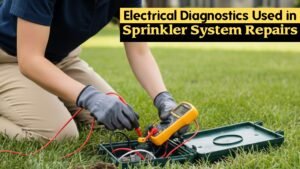
How to Test a Sprinkler Solenoid with a Multimeter
This is the fastest way to confirm replacement.
Resistance Test
- Power off the controller
- Disconnect solenoid wires
- Set multimeter to Ohms (Ω)
- Probe both solenoid leads
Readings:
- 20–60 Ω: Healthy
- Below 10 Ω: Shorted coil
- Infinite / OL: Open circuit
Both failure readings mean replace it.
Voltage vs. Resistance: Electrical Health Check
| Measurement | Healthy Range | Failure Sign | Likely Cause |
|---|---|---|---|
| Resistance (Ohms) | 20–60 Ω | Below 10 Ω | Shorted copper winding |
| Voltage (VAC) | 24–28 VAC | Below 20 VAC | Wiring drop / bad transformer |
If Ohms are good but voltage is low, the solenoid may be innocent.
Pro-Level Test: Check from the Controller First
Before digging, test resistance at the controller terminals.
- High Ohms at controller
- Normal Ohms at valve
That means a field wire problem, not a bad solenoid. Usually corrosion or a nicked wire underground. This test saves unnecessary replacements.
Why Do Sprinkler Solenoids Fail Prematurely?
Electrical Surges
Lightning and power fluctuations damage coils. This often shows up later as intermittent failures.
Electrolysis and Galvanic Corrosion
Stray electrical current in moist soil accelerates wire decay. Resistance climbs. Heat builds. Failure follows.
Poor Wiring Splices
Standard wire nuts fail underground. Always use grease-filled connectors.
Hard Water Scaling
White crust or pitting inside the solenoid tube means the plunger is fighting friction every cycle.
Inrush Current vs. Holding Current
Solenoids need more power to open than to stay open.
- Inrush current: Lifts the plunger
- Holding current: Keeps it lifted
A weak solenoid may hold once open but fail to open consistently. That’s why zones work “sometimes.” It’s not random. It’s physics.
The Hidden Culprit: The Master Valve Solenoid
If all zones fail at once, check the Master Valve. The master valve solenoid runs every time any zone runs. That means more cycles and faster wear. It often fails before zone solenoids Many systems get misdiagnosed here.
AC vs. DC Latching Solenoids
Not all solenoids are the same.
- 24VAC solenoids: Two black wires. Standard controllers.
- DC latching solenoids: Often red/black wires. Battery or smart timers.
DC solenoids use pulses to open and close. Testing them like AC solenoids gives false readings. Never mix these types.
The Compatibility Rule: Can You Mix and Match Solenoids?
Short answer. No.
| Valve Brand | Compatible Solenoids |
|---|---|
| Rain Bird | Rain Bird only (DV, DVF, PGA) |
| Hunter | Hunter only (PGV, SRV) |
| Irritrol / Toro | Often interchangeable with each other |
Rule: If it doesn’t spin in smoothly by hand, it’s wrong. Never force threads.
Water Hammer and Solenoid Health
As springs weaken, valves may close too fast or too slow.
- Too fast → Water Hammer (banging pipes)
- Too slow → Wasted water and seepage
Replacing a worn solenoid can actually protect the valve body and plumbing.
Solenoid vs. Valve Replacement: What Makes Sense?
| Scenario | Best Fix | Labor Effort (1–10) |
|---|---|---|
| Buzzing, bad Ohms | Replace solenoid | 2 |
| Won’t shut off | Solenoid + diaphragm | 4 |
| Brittle valve body | Replace valve | 8 |
Labor matters. Sometimes replacing the whole valve is cheaper long-term.
Winterization and Solenoid Lifespan
Water trapped in a solenoid during freeze expands. Plastic cracks. Plungers bend.
After blowouts:
- Click solenoids open and closed
- Let residual water drain
- Keep valve boxes dry
This small habit prevents spring failures.
3-Step Replacement Checklist
- Identify – Confirm valve brand and model on the bonnet
- Verify – Test Ohms at the controller and valve
- Waterproof – Use DBY or DBR/Y grease caps. Never dry wire nuts
Final Thoughts
Solenoids don’t fail without warning. They buzz. They hum. They hesitate. If you test early, replacement is cheap and easy. Ignore the signs, and failures spread.