Sun exposure mapping for irrigation planning plays a critical role in modern landscape management. Lawns and planting beds rarely receive uniform sunlight. Some areas bake under direct sun all day, while others remain shaded for hours. Treating these zones the same leads to overwatering, underwatering, and turf decline.
Property managers often focus on soil type and sprinkler layout but overlook sunlight distribution. That oversight increases water waste and plant stress. Sun intensity directly affects evapotranspiration rates, soil moisture loss, and root health.
Strategic sun exposure mapping for irrigation planning allows you to divide landscapes into precise watering zones. When irrigation matches sunlight conditions, plant performance improves and utility costs decline.
Why Sunlight Matters in Irrigation Design
Sunlight controls how quickly water evaporates from soil and plant surfaces. Areas exposed to full sun lose moisture faster than shaded sections.
Heat buildup increases transpiration. Grass and plants release more water through leaf surfaces during hot afternoons. Without adjustment, irrigation systems underperform in sunny zones and oversaturate shaded areas.
Sun exposure mapping for irrigation planning corrects this imbalance by aligning watering schedules with actual light conditions.
The Science Behind Evapotranspiration
Evapotranspiration combines two processes:
- Evaporation from soil surface
- Transpiration from plant leaves
Higher solar radiation accelerates both. Landscapes with uneven sun patterns require customized irrigation timing and volume.
Ignoring sunlight variability forces systems to operate inefficiently.
What Is Sun Exposure Mapping?
This YouTube video below from Garden Fundamentals explains how to map sun and shade in your garden. It shows a simple way to track light patterns for better planting decisions. The guidance helps readers place plants where they will grow best.
Sun exposure mapping for irrigation planning involves identifying how sunlight moves across a property throughout the day. It documents duration, intensity, and seasonal changes in sun coverage.
The process divides landscapes into sunlight zones. Each zone receives irrigation based on exposure level.
Common Sunlight Categories
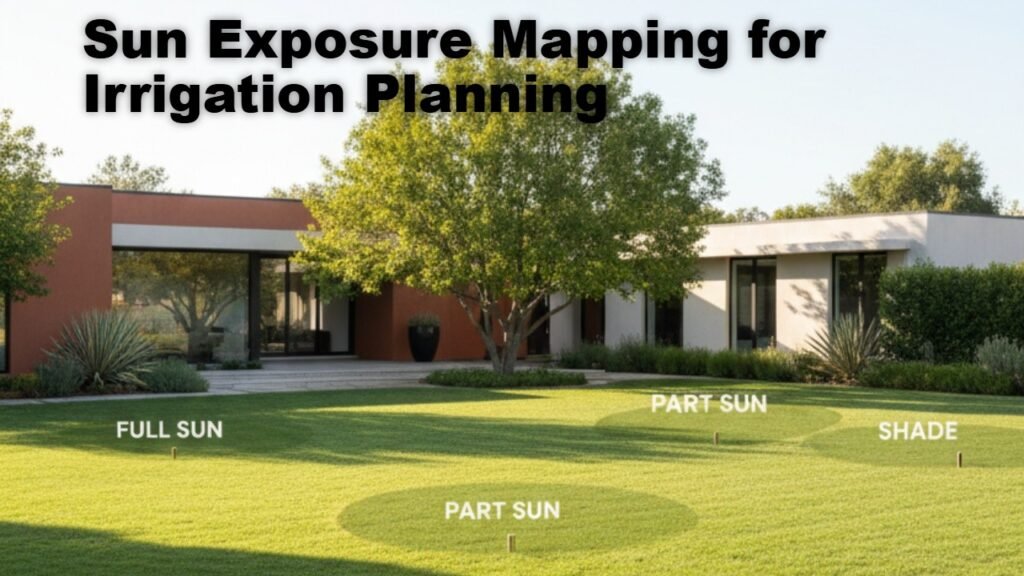
Most landscapes fall into four practical categories:
- Full sun (6+ hours direct sunlight)
- Partial sun (4–6 hours)
- Partial shade (2–4 hours)
- Full shade (less than 2 hours)
Mapping these areas improves irrigation zoning decisions.
How to Conduct Sun Exposure Mapping for Irrigation Planning
This YouTube video below from Pretty Purple Door Garden Design explains how to create a sun map for your garden. It walks through tracking sunlight patterns and noting shade areas. The guidance helps readers choose plants that match their garden’s light conditions.
Effective mapping requires observation, documentation, and analysis. Guesswork produces inaccurate irrigation design.
Step 1: Observe Sun Patterns
Monitor your landscape during different times of day. Track sunlight in morning, midday, and late afternoon.
Repeat observations during different seasons. The sun’s angle shifts significantly between summer and winter.
Step 2: Create a Property Sketch
Draw a scaled layout of your lawn and planting beds. Include:
- Buildings
- Trees
- Fences
- Hardscapes
- Slopes
Mark shaded and sunny areas during each observation period.
Step 3: Identify Microclimates
Microclimates form due to reflected heat from structures. South-facing walls often intensify heat exposure.
Concrete and asphalt increase soil temperature nearby. Those areas demand higher irrigation adjustments.
Sun exposure mapping for irrigation planning must account for these variations.
Integrating Sun Mapping with Irrigation Zoning
Proper zoning ensures each sunlight category receives appropriate watering. A single irrigation zone rarely meets the needs of mixed light conditions.
Adjusting Water Volume by Sun Zone
Sunny areas typically require:
- Longer run times
- Higher watering frequency
- Soil moisture monitoring
Shaded areas require:
- Reduced watering duration
- Less frequent irrigation
- Drainage evaluation
Balancing zones reduces runoff and fungal growth.
Smart Controllers and Sun-Based Scheduling
Modern irrigation controllers allow zone-specific programming. Smart systems adjust watering schedules using weather data and evapotranspiration rates.
Combining smart technology with sun exposure mapping for irrigation planning enhances precision.
Impact on Turfgrass Health
Turfgrass reacts strongly to sunlight variation. Warm-season grasses tolerate intense sun better than cool-season varieties.
Sunny lawns often show drought stress first. Shaded lawns may struggle with thinning and disease.
Sun exposure mapping for irrigation planning prevents uneven turf quality across properties.
Signs of Sun-Related Water Imbalance
Look for these indicators:
- Brown patches in high-sun areas
- Mushy soil in shaded zones
- Fungal outbreaks in damp sections
- Shallow root growth
- Uneven color patterns
Addressing sunlight differences resolves many recurring lawn issues.
Soil Temperature and Root Development
Soil temperature influences root growth. Full-sun zones heat up faster and lose moisture rapidly.
Higher soil temperatures increase microbial activity but also stress roots. Shaded areas retain cooler soil, slowing evaporation but sometimes limiting growth.
Sun exposure mapping for irrigation planning aligns water delivery with soil temperature conditions.
Water Conservation Benefits
Water efficiency remains a top concern for property managers. Uniform irrigation wastes thousands of gallons annually.
Sun exposure mapping for irrigation planning reduces overwatering in low-light areas. Water savings become measurable within a single season.
Lower consumption also reduces runoff and nutrient leaching.
Environmental Advantages
Improved irrigation accuracy delivers:
- Reduced fertilizer loss
- Lower disease treatment needs
- Healthier soil biology
- Fewer pest outbreaks
Sustainable landscapes require sunlight-based irrigation adjustments.
Seasonal Adjustments and Solar Angle Changes
This YouTube video below from Khadija Academy explains the practical tilt angle of solar panels and how to adjust it for seasonal changes. It shows how tilt affects energy output and efficiency. The overview helps readers understand smarter solar panel positioning.
The sun’s path shifts throughout the year. Areas shaded in winter may receive full sun in summer.
Property managers should update sun exposure mapping for irrigation planning annually. Seasonal calibration keeps systems accurate.
Spring and Summer Considerations
During summer:
- Increase watering in full-sun zones
- Monitor heat stress weekly
- Adjust smart controller settings
During cooler seasons:
- Reduce watering frequency
- Watch for drainage issues
- Prevent oversaturation
Continuous monitoring prevents costly corrections later.
Technology Tools for Accurate Mapping
Advanced tools simplify sunlight analysis. Professional property managers often rely on digital resources.
Useful Tools Include:
- Solar pathfinder devices
- Smartphone sun tracking apps
- GIS mapping software
- Drone-based aerial imaging
- Soil moisture sensors
Technology enhances accuracy but does not replace field observation.
Sun exposure mapping for irrigation planning works best when digital tools and manual assessment combine.
Landscape Design Considerations
Landscape design influences sun distribution. Tree placement, building orientation, and hardscape layout affect exposure levels.
Strategic planting can reduce excessive sun stress. Shade trees lower soil temperature and water demand.
Design modifications should complement irrigation adjustments.
Common Mistakes in Sun-Based Irrigation Planning
Property managers often repeat preventable errors.
Avoid These Issues:
- Treating all zones equally
- Ignoring seasonal changes
- Overwatering shaded areas
- Failing to monitor soil moisture
- Relying only on timer-based systems
Sun exposure mapping for irrigation planning prevents these costly missteps.
Practical Implementation Checklist
Follow this structured plan to apply sunlight mapping effectively:
- Conduct seasonal sun observations
- Divide landscape into exposure zones
- Adjust irrigation programming per zone
- Install soil moisture sensors
- Audit system performance quarterly
- Document changes for future reference
Consistency drives long-term results.
Cost Implications for Property Managers
Initial mapping requires time and planning. However, long-term savings outweigh upfront effort.
Reduced water bills, fewer plant replacements, and lower maintenance costs deliver measurable returns.
Sun exposure mapping for irrigation planning supports responsible budget management across large properties.
FAQs About Sun Exposure Mapping for Irrigation Planning
How often should sun exposure mapping be updated?
Update at least once per year or after major landscape changes.
Can smart irrigation systems replace manual sun mapping?
Smart systems enhance accuracy but still require proper zoning based on sunlight patterns.
Does sun mapping help with plant selection?
Yes. Identifying sun levels allows better plant placement and reduces irrigation stress.
Is sun exposure mapping necessary for small lawns?
Even small lawns experience uneven sunlight. Proper zoning improves water efficiency regardless of size.
How long does mapping take?
Basic mapping takes several days of observation across different times of day.
Conclusion
Sun exposure mapping for irrigation planning transforms how landscapes receive water. Uneven sunlight demands tailored irrigation strategies. Ignoring light distribution leads to wasted water and declining turf health.
Property managers who invest in sunlight analysis gain measurable control over plant performance and operational costs. Zoned irrigation based on real sun patterns protects soil structure and root development.
Precise watering begins with understanding sunlight behavior across your property. Evaluate your landscape today and apply sun exposure mapping for irrigation planning to create a smarter, more resilient irrigation system.