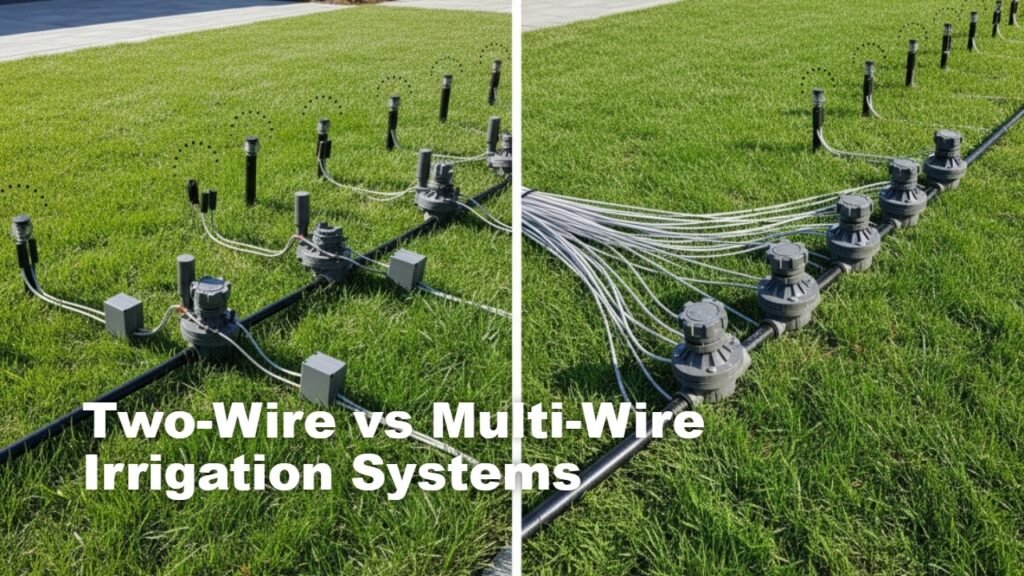
Two-Wire vs Multi-Wire Irrigation Systems is one of the most important decisions in large-scale irrigation design. The wiring method controls how valves communicate with the controller. That communication determines scalability, installation complexity, and long-term maintenance costs.
Homeowners with large estates and property managers overseeing commercial landscapes must understand this difference. Choosing the wrong system can increase labor expenses and limit expansion. Selecting the right wiring architecture ensures flexibility, reliability, and efficient water management.
This guide explains how both systems work, where each performs best, and how to choose the right option for your property.
Understanding Irrigation Control Wiring Basics
Irrigation systems rely on low-voltage electrical signals to activate valves. The controller sends a signal through buried wires. When a valve receives that signal, it opens and allows water to flow.
The wiring configuration determines how those signals travel underground. That configuration separates traditional multi-wire systems from modern two-wire technology.
Core Components in Both Systems
Both designs include:
- Irrigation controller
- Solenoid valves
- Field wiring
- Valve boxes
- Power source
The difference lies in how wires connect those components.
What Are Multi-Wire Irrigation Systems?
This YouTube video below from Tempo Communications explains how to troubleshoot multiwire irrigation systems. It covers common wiring faults, testing methods, and repair steps. The guidance helps readers diagnose and fix electrical issues in sprinkler systems.
Multi-wire irrigation systems use a dedicated wire for each valve. Every valve connects directly back to the controller through an individual control wire. A common wire completes the circuit.
This design has served residential properties for decades. Smaller systems with fewer zones often use multi-wire setups because they are straightforward.
How Multi-Wire Systems Work
Each zone requires its own strand of wire running from the controller to the valve. For example, a 12-zone system needs 13 wires: one common wire plus 12 individual zone wires.
As zones increase, the wire bundle becomes larger and more complex.
Advantages of Multi-Wire Systems
- Simple troubleshooting
- Lower upfront cost for small properties
- Easy understanding for technicians
- Widely available components
Multi-wire systems work well for properties with limited zones.
Limitations of Multi-Wire Systems
- Complex wiring for large landscapes
- Labor-intensive trenching
- Higher copper usage
- Difficult expansion beyond installed wire capacity
Large commercial properties may find this structure restrictive.
What Are Two-Wire Irrigation Systems?
Two-wire irrigation systems use only two wires to control multiple valves. Instead of separate wires for each zone, the system sends digital signals along a single two-wire path.
Each valve connects to a decoder. The decoder interprets signals from the controller and activates the assigned valve.
How Two-Wire Systems Operate
The controller sends coded electrical signals through two conductors. Each decoder has a programmed address. When the controller calls a zone, only the decoder with that address responds.
This method dramatically reduces field wiring.
Advantages of Two-Wire Irrigation Systems
- Minimal trenching
- Lower copper requirements
- Scalable zone expansion
- Cleaner installation
- Ideal for large properties
Two-wire architecture simplifies complex irrigation networks.
Limitations of Two-Wire Systems
- Higher upfront equipment cost
- Requires decoder programming
- More technical troubleshooting
Despite these factors, large sites often benefit from long-term savings.
Installation Complexity Comparison
Two-Wire vs Multi-Wire Irrigation Systems differ significantly in installation requirements.
Multi-wire setups require running multiple wires from the controller to each valve location. As zone count increases, trenching and labor costs rise.
Two-wire systems need only one continuous two-conductor path. Installers branch decoders off the main wire path, reducing trench volume.
Labor Considerations
Multi-wire systems demand careful labeling and routing. Wire bundles grow thicker as zones increase.
Two-wire systems streamline installation but require precise decoder programming.
Scalability and Expansion
Scalability often determines the best choice between Two-Wire vs Multi-Wire Irrigation Systems.
Multi-wire designs limit future expansion to available spare wires. Once the wire bundle reaches capacity, adding zones requires additional trenching.
Two-wire systems allow new decoders to connect anywhere along the wire path. Expansion becomes far more flexible.
Ideal Applications
Multi-wire works best for:
- Small residential properties
- Systems under 12 zones
- Straightforward layouts
Two-wire works best for:
- Commercial campuses
- Golf courses
- Large estates
- Municipal properties
Growth potential strongly favors two-wire solutions.
Troubleshooting and Maintenance
Maintenance differs between Two-Wire vs Multi-Wire Irrigation Systems.
Multi-wire systems allow technicians to test individual zone wires easily. Fault isolation is straightforward because each valve has a dedicated conductor.
Two-wire systems require signal tracing and decoder diagnostics. Specialized testing tools help identify breaks or communication faults.
Maintenance Tips
For multi-wire systems:
- Label wires clearly
- Protect wire splices
- Avoid moisture exposure
For two-wire systems:
- Use waterproof connectors
- Maintain decoder mapping records
- Inspect grounding systems
Both systems require periodic inspection to ensure reliable communication.
Cost Analysis
Cost varies depending on property size.
Multi-wire systems typically cost less upfront for small projects. Materials are simple and widely available.
Two-wire systems may have higher controller and decoder costs. However, reduced trenching and copper use can offset expenses on large properties.
Long-Term Value
On large landscapes, two-wire systems often reduce:
- Installation labor
- Copper wire expense
- Expansion costs
- Future retrofitting
Multi-wire systems remain economical for limited zone counts.
Performance and Reliability
Performance depends on proper installation and grounding.
Multi-wire systems rely on direct electrical paths. Signal loss is rare unless wires break.
Two-wire systems depend on digital communication. Proper grounding and surge protection ensure stable operation.
Surge Protection
Both systems benefit from:
- Lightning protection
- Grounding rods
- Surge suppression devices
Large properties especially require surge safeguards.
Choosing the Right System
Selecting between Two-Wire vs Multi-Wire Irrigation Systems depends on property size, growth plans, and budget.
Ask these questions:
- How many zones are required now?
- Will the system expand later?
- What is the trenching cost?
- Is future scalability important?
- How complex is the landscape layout?
Thoughtful planning prevents expensive redesigns.
Practical Advice for Property Managers
Professional oversight ensures the right investment.
- Request zone expansion projections
- Review wiring diagrams before installation
- Evaluate long-term maintenance capacity
- Factor copper cost into budgeting
- Confirm surge protection measures
Strategic planning supports efficient irrigation management.
FAQs
What is the main difference between two-wire and multi-wire systems?
Multi-wire uses separate wires for each valve. Two-wire uses digital signals over two conductors with decoders.
Are two-wire systems better for large properties?
Yes. Two-wire systems scale easily and reduce trenching on large landscapes.
Is multi-wire cheaper?
For small properties, multi-wire systems usually cost less upfront.
Can multi-wire systems be upgraded?
Upgrades may require additional wiring if spare conductors are unavailable.
Do two-wire systems require special tools?
Yes. Technicians use diagnostic equipment to troubleshoot decoders and communication lines.
Conclusion
Two-Wire vs Multi-Wire Irrigation Systems represent two distinct approaches to irrigation control architecture. Multi-wire systems offer simplicity and lower upfront cost for small properties. Two-wire systems provide scalability, cleaner installation, and long-term flexibility for large landscapes.
Property owners must weigh expansion potential against initial investment. Smart planning today prevents infrastructure limitations tomorrow. Explore advanced irrigation control solutions and discover which system best supports your property’s future growth.